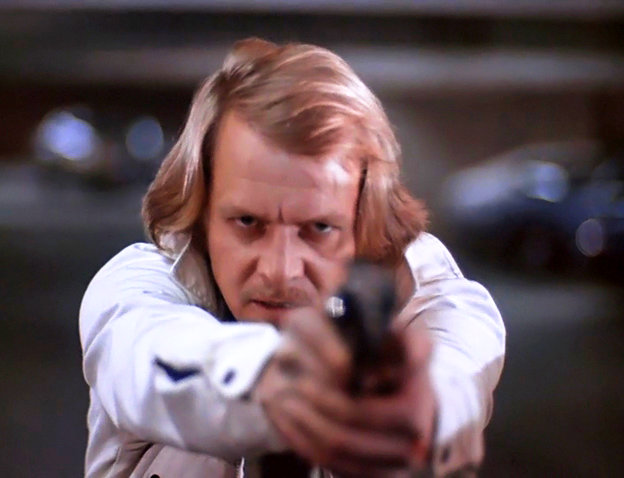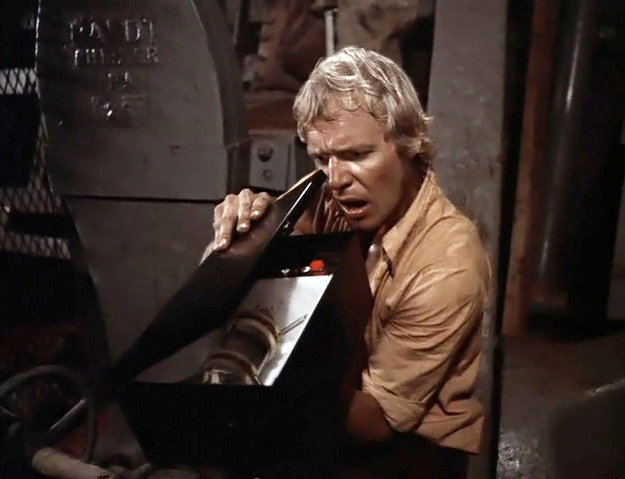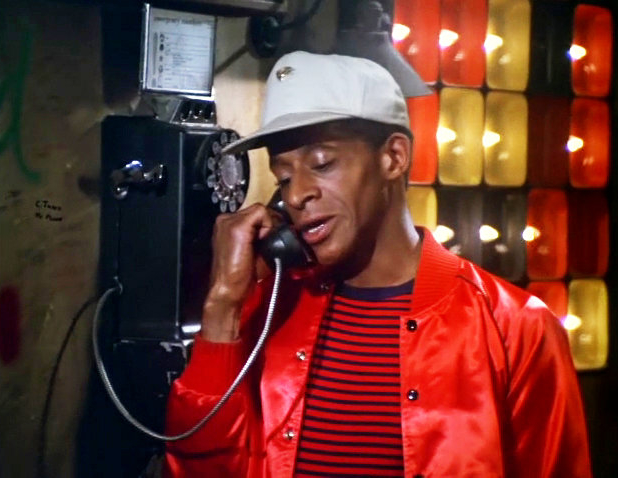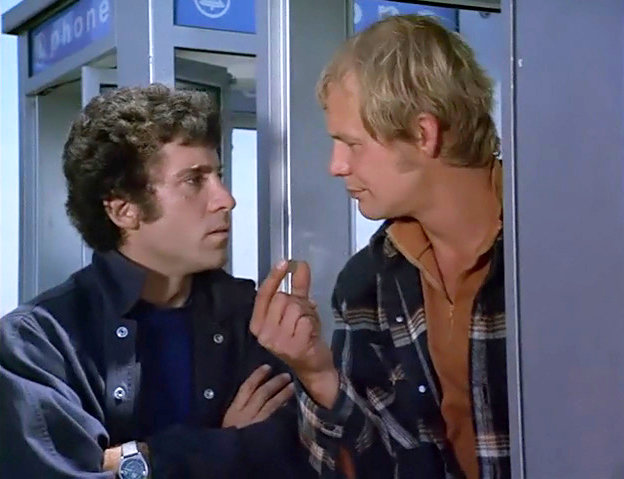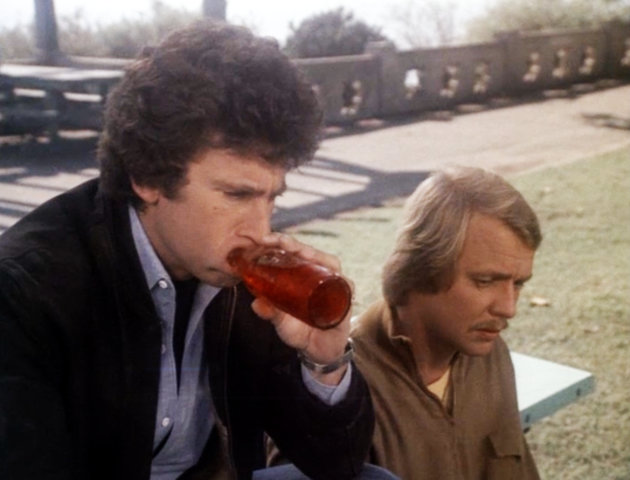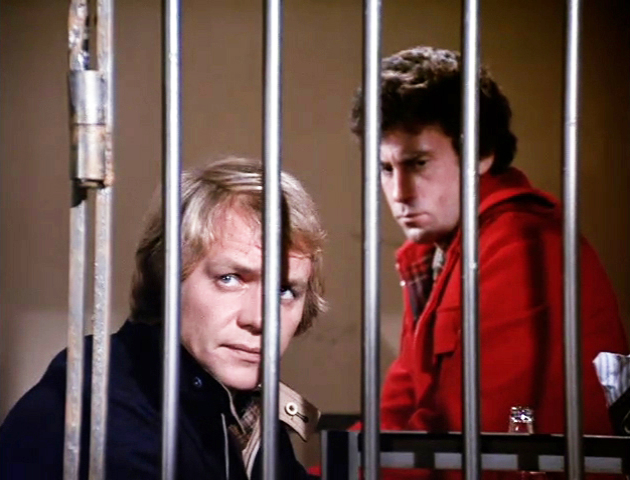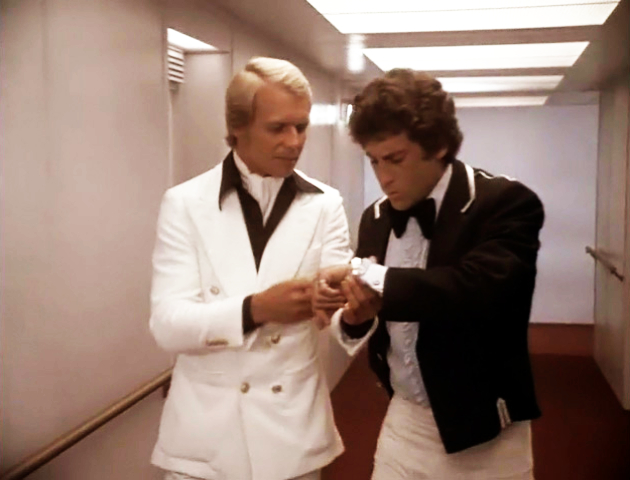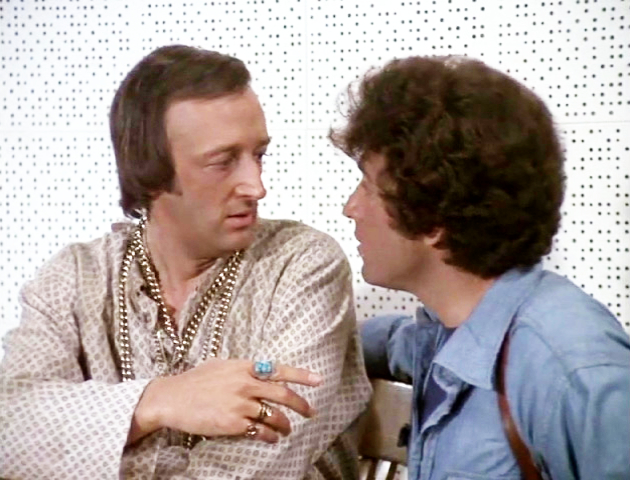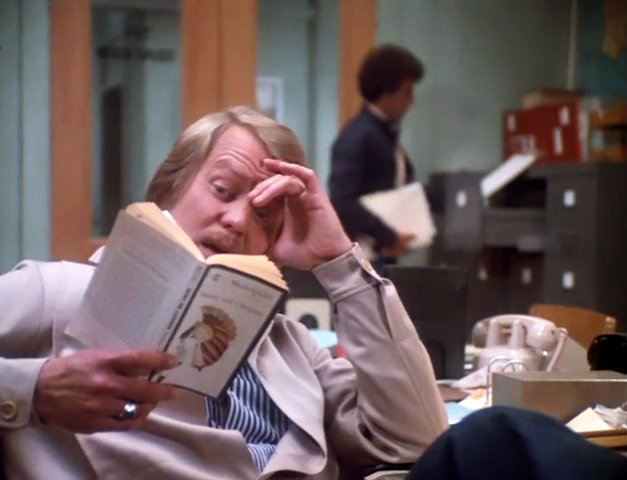

“Yeah, well, you and Todesco ought to write a book together.”
(Class in Crime)
An Introduction to Book Club Questions
First, get a hold of some pals.
Second, prepare a nice snack. Perhaps a plate of rum-raisin bon-bons? (The Golden Angel) A basket of the ‘staff of life’? (Huggy Can’t Go Home) Belle Kates chili with all the fixins’? (The Hostages) Or go all out and make the Paul Muni Special. (Lady Blue)
Now everyone get comfortable in the living room, on the porch, or in front of the computer screen.
Then dive right into some Book Club questions.
The questions are ones that occurred to me while I was working on this project. Some are serious, some very silly. Most are in-between. Most ask direct questions, but some are simply observations.
Book Club Questions A
“You know coming down here to watch
you sweat is not the high point of my day.”
(Pilot)
- 1. While wrapping up the series, there are quite a few iconic references to previous seasons. The Miranda Rights are read in their completion. There is running water in the gym shower and the hospital’s sprinkler. There is shared food, coffee and a Danish to stuffed veal and antipasto. Hutch wears his two-leather jacket. Starsky and Hutch visit a porno theater with Huggy. And in both ends, a bullet-ridden Torino appears in the police garage. Name some other symbolic nods. And what, besides the Starsky Sweater, is missing? (Pilot, Sweet Revenge, Targets Without a Badge: Part 3)
- 2. Johnny Bagley’s Ernie and Hutch’s Starsky are both shot and left to burn to death in a building. Compare and contrast these two characters and their circumstances. (The Trap)
- 3. If Starsky hadn’t seen Gillian at the Venus, how long would it have taken Starsky, and or Hutch, to suspect that Gillian wasn’t on the up and up regarding her profession? Who would have figured it out first? (Gillian)
- 4. Elaborate on the parallels between Billy Joe/Henderson and Starsky/Hutch, two sets of characters in a car with one man a driving fiend and the other begging to stop. (Partners)
- 5. Would Hutch, without a Starsky in his life, really be the arrogant ass, as seen when Hutch fakes amnesia? Take the premise one step further. Explore through an “It’s a Wonderful Life” lens how Starsky and Hutch’s lives would be without each other in it. (Partners)
- 6. Starsky and Hutch refer to White’s henchman, Foote, as “Curly” four times. Hutch is perhaps the whitest/blondest male character in the series. Compare and contrast Starsky and Hutch with White and Curly. Extra points for incorporating the action of small hairs on the back of the neck used when lying. (Losing Streak)
- 7. Hutch refers to he and Starsky as “Lazarus” when uniform asks him. Perhaps Hutch felt they both returned to life with this knowledge? (The Psychic)
- 8. Corsican Brothers were conjoined then separated twin brothers who felt each other’s thoughts. Discuss Colby’s possible jealously regarding to how he views Starsky and Hutch, two men joined at the hip. (The Deadly Imposter)
- 9. Sugar Plum is on stage, nattering away. Just as Sugar says she has, “no drinking problem at all,” John spills his drink. Jack Ives displays his “drinking problem” spilling champagne on himself out of glasses and spilling wine on himself while drinking straight out of the bottle. Pick three characters in Bay City and describe how real drinking problems have affected their lives. Extra credit for mentioning drinks involving a fancy glass and a little umbrella. (Death in a Different Place, The Groupie)
- 10. Harry has sex once every nine months with a woman and then kills her. Harry appears to have issues with his father, which is one reason he doesn’t like the name Harry. A normal human pregnancy lasts nine months, not unlike the gestational time Harry spends in the boiler room/womb. Perhaps Harry is practicing a sort of self-annihilation when he murders women after having sexual relations with them, unconsciously eradicating his possibility of repeating the cycle of what he remembers of fatherhood? (Deckwatch)
- 11. Discuss the boiler room as Hell. (Deckwatch)
- 12. When Jerry hits Kathi, one sees a picture of a shark on the wall behind her. The shark is same color as Jerry’s shirt. Describe the possible symbolism. (Death Notice)
- 13. “Degenerates…sickos…bums,” Fifth Avenue calls Solenko and his bunch. “They give an honest thief like me a bad name.” Compare Fifth Avenue’s credo to Starsky and Hutch’s reasoning for the Angel to give them information on the two hypes that killed Emma Lou. Starsky and Hutch explain to Angel Huey Chaco and John Brown Harris “give heroin addicts a bad name.” Then observe the way Starsky and Hutch treat Cheryl Waite, self-admitted drug runner and possible prostitute, with a lobster lunch, an offer to stay at Hutch’s place, and help packing for a trip. Where is the gray line drawn in Fifth Avenue, Angel, and Starsky and Hutch’s heads as they make the distinction between an honorable bad person and one that is not? (Lady Blue, The Bait, Texas Longhorn)
- 14. As Starsky is bleeding to death on the couch, Hutch asks him, “What time you got?” Without medical attention, frankly not much time at all. Does Hutch understand the double meaning of his question? Does Starsky? (Shootout)
- 15. Ellie Cole and Belle Kates have the same color hair. Compare and contrast these two characters. (The Hostages)
- 16. Jesse quotes St. Matthew: “Beware of false prophets that come to you in sheep’s clothing and inwardly are ravenous wolves.” She is saying this about Starsky and Hutch and plainclothes fuzz, but her instincts are way off in regards to Kim and “Father.” Then again, she has been convicted of armed robbery, which perhaps puts her good judgment in question. Discussion question: Is Jessie as savvy as she appears to be? (Silence)
- 17. Both Starsky and Hutch have a wooden wheel with six spokes: Hutch’s is in his car. Starsky has one on his apartment wall. Imagine a conversation or reason they each have this visual in their possession. (Jojo, Running)
- 18. Both Starsky and Hutch get their gun arms tangled in the theater curtains at the Nuart as they enter the auditorium. When are some other times Starsky and Hutch physically act like both sides of the same coin in the same situation? (Silence)
- 19. Is Starsky’s consumption of some of the popcorn before he throws it at “Father Ignatius” a sort of anti-communion? (Silence)
- 20. When “Father Jonas” clutches Molly / Pete and shakes her, there is the distinct sound of what sounds like a rattlesnake. Make three points comparing Father Jonas to a viper. Extra points for reference to Eve. (Little Girl Lost)
- 21. Starsky says to Hutch regarding Duke’s apparel advice, “Everyone is entitled to a mistake.” Hutch makes a little sneer, “Yeah, right…” Later Hutch, after being scolded by Cameron says, “We made a mistake, it won’t happen again.” These comments foreshadow Starsky’s “mistake” when he doesn’t trust Hutch about Jack and comments on “his stinking loyalty.” (The Las Vegas Strangler)
- 22. Joey steals a watch. Starsky and Hutch take this seriously but her mom doesn’t. Molly / Pete steals food. Starsky and Hutch don’t take this seriously but Mike does. Compare and contrast these two scenarios. Extra points for intertwining the fact that both girls are played by the same actress. (Little Girl Lost)
- 23. Discuss the innuendos displayed regarding Venus Massage. Mrs. Grossman offers “hard candy” to Starsky and Hutch. Joy offers a massage to Starsky to “take that stiffness right out.” Mrs. Grossman disingenuously says her business deals only in whistles and tricks. She gives Starsky the “wolf whistle.” (Gillian)
- 24. Starsky goes to hospital and misses his pants. Hutch goes to hospital and misses his jacket. Is this a kind of medical strip poker? (A Coffin for Starsky, Vendetta)
- 25. Diana and Abby each invite Hutch to dinner, put a gift on his plate, and wait for a late Hutch. Both relationships end badly. What are the differences and similarities between these two women? (Fatal Charm, Vendetta)
- 26. Tommy attacks Eckworth with a baseball bat. If he had to pick weapons to “match” three of his other victims in a symbolic way, what would he pick for the laundry worker, the pimp, and Abby? (Vendetta)
- 27. Who is uglier, Leo Moon or Vic Humphries? Why? Extra credit for not mentioning Moon’s moobs. (Captain Dobey, You’re Dead, Survival)
- 28. Mac Senior sits on the fire truck after his son’s murder. The truck is a Mack truck. When Mac Senior tells Hutch that he told Mac Junior his job as a policeman would make him come to a bad end, could he have possibly seen it in this detail? Or is that a job for Joe Collandra? (The Specialist, The Psychic)
- 29. Starsky complains that his food is “too greasy.” Take this as the first clue that he is feeling contrary and run with it. (The Psychic)
- 30. Marianne Tustin says regarding her brother’s affair with Marsha, “Ted’s one failing. He loved his wife, adored his kids, but he loved to play.” The very next thing she says is, “My brother always had a very bad temper, I mean a really bad temper.” Does Marianne not consider this a failing? Or having grown up with him, doesn’t take his temper seriously? Do you think his wife and children feel the same? (Tap Dancing Her Way Right Back Into Your Heart)
- 31. Hutch says, regarding blood in bathroom, “If it’s Starsky’s blood it won’t matter.” This is the same man that told Dobey he didn’t care if he had two minutes, he wasn’t giving up? (Bloodbath, A Coffin for Starsky)
- 32. Hutch speculates the singing goldfish grew up and their voices changed. Starsky tells Lisa Peter Pan is always ten years old, and Starsky hadn’t seen Peter Pan for a long time. Mitzi comments the puppy will be all grown up in six months, but Lisa never will grow up, which Mitzi likes as she loves being a mommy. Hutch comments the bratty kid at the toy store will grow up and Lisa will stay sweet. Hutch says, “Kids grow up…the world marches on.” What do all these things mean for the three characters Lisa, Mitzi, and Starsky? (Nightmare, The Crying Child)
- 33. How much of Mitzi’s statement that she loves being a mommy and is glad Lisa will never grow up a real feeling or a rationalization for circumstances that can’t be altered? (Nightmare)
- 34. Al and Olga Grossman mention “this” has happened to Gillian before. “This” is apparently Gillian falling in love with a really special guy and wanting to get out of the prostitution business. Does knowing Hutch isn’t the first man Gillian has fallen for make her a more or a less sympathetic character? (Gillian)
- 35. Sonny sings “Glory Hymn of the Republic” while he tramps about in the canyon. The piano tuner at Huggy’s plays bits of it as he tunes the piano. Speculate on the possible significance in having the same tune in both places? (Survival)
- 36. The radio announcer talks about listening. Sonny complains that no one ever listens to each other anymore when cops ignore him. Bobby and his mother don’t communicate well. Hutch doesn’t communicate with Starsky when he goes to meet Lou. And due to his war injuries, Sonny’s ability to listen is reduced. Discuss the theme of communication in this episode. (Survival)
- 37. Hutch, trapped under his car, curses “All America on wheels, what a joke.” This is the Ford Motor Company that “put America on wheels,” and Henry Ford used this slogan. How does this tie in with Hutch’s desperate outburst? (Survival)
- 38. Burke and Corman say, “If we wanted to snuff him (Crandell), we could have wasted him resisting arrest.” Man, that’s cold. These guys have been on the street too long. Explore these cops in relation to Hutch’s comment about Mike Ferguson having been out so long he couldn’t differentiate the forest from the trees. What’s the difference between these three cops and Captain Dobey who’s been out 27 years longer than any of them? (Iron Mike, Snowstorm)
- 39. Forest asks Monk, “Why is it you are always wrong?” Is this true? (The Fix)
- 40. Is the episode “Huggy Bear and the Turkey” a distinct fan non-favorite because of the lack of Starsky and Hutch? Because until the end, Starsky and Hutch act disinterested in solving a crime? Is it because it is boring? Because Turquet as a character comes out of nowhere? Or other reasons? (Huggy Bear and the Turkey)
- 41. Extrapolate on the possible multiple meanings, verb and noun, behind the title “The Fix.” (The Fix)
- 42. Both Hutch and Slater have a bandage on their left pinky finger. Hutch cut his when he was making dinner for a date. Did Ray cut it when he was making dinner for Carla? Create a scenario that ties this small detail to something that happened in the episode. (Survival)
- 43. Aside from not ignoring calls and flirting with Chris less, Starsky and Hutch don’t behave that much differently after her scathing article than before. (The Heroes)
- 44. When Starsky tells Hutch to “play the bad guy for a change,” is it because he feels he ends up playing the bad cop more than Hutch? Provide three examples that support your argument. (Snowstorm)
- 45. Amboy’s henchman says the “weekend take” is $141,000. This amount of money turns into $140,000 at Dobey’s. Did Starsky and Hutch siphon off $1000? They “take” money for Vicky’s daughter so you know they are capable of a little under-the-radar filching under what they would consider a good reason. If they did take $1000 off the top, what would they use it for that would be justifiable in their minds in the episode with Amboy? (Bust Amboy, The Las Vegas Strangler)
- 46. Did Iron Mike recognize Starsky and Hutch from Harry’s restaurant or not? What are some clues he did? What are some clues he didn’t? And how would this play out in his request to work with them? (Iron Mike)
- 47. Is Artie sleeping with Tommy? Is he sleeping with the other boys? What are the clues that he is? That he isn’t? (Vendetta)
- 48. Belinda tells Hutch he wouldn’t know how she felt to be so desperate as to sell Vic Rankin. What is going through Starsky and Hutch’s minds as they remember Hutch’s experience with heroin? (Losing Streak, The Fix)
- 49. Wally Stone says he “took the rap” for Steve. Does this mean it was Steve who pushed Jane Elexy out the window? Steve is clearly going to say something else to Starsky and Hutch as they go out the door, but changes his mind. Is there anything else to support the theory Wally did time for one or more of a member of the Wolf Pack’s crime? (Murder on Stage 17)
- 50. Starsky gives Hutch “woman advice,” and tells him not to worry about Diana. Starsky tells Hutch to “count on me,” which turns out to be a bad decision. Is this Starsky’s only instance of poor female advice? (Fatal Charm)
Book Club Questions B
“Esta Ramon aqui?”
(The Velvet Jungle)
- 51. You know Thistleman is a bum when he parks at work in a “20 minute zone.” You know Ben Forest is a bum when he wears his hat indoors. Name some other characters that display poor manners and three other characters that show good manners as a symbolism of their morals. (The Set-Up, The Fix)
- 52. “My conscience is as clear as any man’s,” Mike Ferguson says to Starsky and Hutch. Watch the look on Hutch’s face and Ferguson’s face as this is said. Is this comment on conscience necessarily reassuring? (Iron Mike)
- 53. It is insinuated that Laura’s father was a cop and was killed in the line of duty. Is this why she won’t date Hutch or is it something more? (Deckwatch)
- 54. Why does Dobey tell Starsky after Prudholm kills a second cop and calls Metro, “Your friend called you again,” when he is trying to keep Starsky’s head together? (Pariah)
- 55. “At the time, I didn’t put it together but I saw gum wrappers folded exactly like that at Ted Bank’s apartment.” This means Starsky is having Billy checked out even before he and Hutch go to have dinner at the Blake’s and before he understands the gum wrapper clue. What makes Starsky go down that track? Just general paranoia due to his job or is it something else? (Terror on the Docks)
- 56. The whole conversation with Hutch, Starsky, and Dr. Franklin when Starsky is first taken to the hospital has the undercurrent that they’re speaking about sexual assault. How would this episode play differently if this were the case, with or without the twenty-four hour deadline? (A Coffin for Starsky)
- 57. Memo to Huggy: When you get that Commendation from the Police Department for your help, don’t put it on your wall—it might hurt your street cred. Explore the ways Huggy has to work both sides of the fence to remain effective both as a friend to Starsky and Hutch while keeping his street reputation intact.. (Snowstorm)
- 58. Why does Hutch say to Starsky regarding Gillian that “you never did like her” or “understand her”? Does Hutch feel this is true or is he reacting out of blunt grief? (Gillian)
- 59. Gillian professes her love for Hutch eight times, seven directly to Hutch. Hutch never uses the word in return. Does he express it in other ways than verbal? Does he love her? Who else does Hutch express his love to in the series, other than to Starsky? (Gillian)
- 60. Starsky asks Dr. Quo, “What you are saying is she’s going to die. It is only a matter of when.” Contrast this with Starsky’s comment to Tallman, “Even dying’s a living.” (Pilot, Starsky’s Lady)
- 61. It isn’t really money Tabor wants from Sue Ann, it’s to be remembered. Even Sue Ann says to him that the money doesn’t mean anything to her either. At one point in the episode, she says that perhaps the money would even things out. How are Sue Ann and Tabor both sides of a karmic coin? Extra credit for discussion regarding Sue Ann Grainger’s “willingness” to take on Tabor’s blame as an example that of Professor Gage’s theory, “The victor and as well as the victim is responsible for his life and death…” and “the subtle and obvious ways we choose our own executions.” (Long Walk Down a Short Dirt Road, Class in Crime)
- 62. “Thy hand, great Anarch, lets the curtain fall and universal darkness buries all.” Voltaire 1744, says Zane. Fat Rolly says nervously, “I knew that.” In fact, they are both wrong. It is from Alexander Pope’s “Dunciad.” Does this exchange make Zane or Rolly look like a bigger idiot? Knowing he gets literary quotes wrong make Zane a more or less effective bad guy? And is there any significance to Zane’s choice of Pope’s literary satire as his reading material? (Pilot)
- 63. Hutch complains about his hand while in the emergency room. Starsky tells him it is just a scratch, downplaying Hutch’s pain. Is Starsky’s dismissal a foreshadowing of the later situation with Diana? (Fatal Charm)
- 64. Why does Hutch refer to the assignment of Anna as one that was “going to be the assignment of my life”? (A Body Worth Guarding)
- 65. Iron Mike defends himself saying, “My conscience is as clear as any man’s.” Dr. Matwick claims, “My conscience is quite clear… the work I do here is of the utmost importance.” How are these two men’s rationalizations the same? How are they different? (Iron Mike, Murder Ward)
- 66. Does the character of Terry Roberts and the episode she is in qualify as a “Terry Sue”? (Starsky’s Lady)
- 67. When Hutch says Ted “has everything he needs…a beautiful family, a good job, a comfortable home,” is Hutch making a general comment regarding a man’s happiness, or just Ted’s? Contrast and compare this to Tony’s comment, “You “work all your life for that dream house, picket fence…” (The Action, Discomania)
- 68. Hutch gives Laura a silly list of jobs he would do if he stopped being a cop, which is his way of saying he has no intention of leaving the profession. Starsky gives Rosey Malone a list of silly jobs as he is evading telling Rosey what he really does for a living. Starsky tells Rosey Malone that he has no more intention of quitting the force as she does of quitting being her father’s daughter. Is Starsky and Hutch’s dedication to their job as much a dedication to the career itself, or to being partners with each other, regardless of the job? Envision Starsky and Hutch as go-cart drivers and sushi chefs. (Deckwatch, I Love You, Rosey Malone)
- 69. Is Starsky, Hutch, and Huggy’s choice of “Somebody Bad Stole the Wedding Bell” foreshadowing the bogus marriage between “Thorne” and Charlotte Connery? Extrapolate. (Starsky and Hutch on Voodoo Island)
- 70. When poisoned, Starsky tells Hutch not to antagonize the people he needs. Later, when Hutch is ill, Starsky antagonizes the people they need. If Hutch were present when Starsky does this, would Hutch point it out? (A Coffin for Starsky, The Plague)
- 71. Why is Starsky skeptical about National Geographic’s article about one hundred forty-eight year old people when he seems to believe just about any other odd trivia? Is Starsky or Hutch a more gullible person? Provide examples. Extra credit for picking Hutch. (The Plague, The Bounty Hunter)
- 72. Is Starsky’s duplicitous with Emily Harrison regarding his identity and interest in her about even with her duplicitous with him regarding her role in the robbery and relationship with Don Widdicombe? Will they have equal amounts of anger for themselves as well as for each other? (Blindfold)
- 73. Starsky isn’t a very good liar, except when he is undercover, says Hutch. Hutch comments that Starsky ought to be “good at” Liars’ Poker. Starsky tells Callendar, “I don’t lie.” Can these three statements coexist and still be valid? (The Action, The Plague)
- 74. Dr. Kaufman says Hutch’s vulnerable upper lip “gets right to a woman’s heart.” Is this why he grows a mustache in Season Four? (The Plague)
- 75. Starsky tells Helen not to touch Ritchie to avoid becoming infected with the plague. She replies, “Do you think I care?” Comment on Helen’s remark and how it relates to Starsky as he fights to go into the sick room with Hutch. (The Plague)
- 76. Compare and contrast the two times Starsky’s name is written in red on something as a message. (Bloodbath, The Plague)
- 77. It is Callendar’s nice shoes that give him away to Hutch. Later, when he comes to the hospital, he is wearing ratty tennis shoes. Was Callendar’s mistake of the nice shoes because he was sloppy when he wasn’t feeling well? Or for another reason? (The Plague)
- 78. Hutch knows John-John, but Starsky doesn’t, as it is pointed out the collector is working Hutch’s neighborhood. Hutch tells Starsky, “Every snitch on your circuit…” is talking about Starsky and Emily. How much of Starsky and Hutch’s professional lives don’t overlap? And what are some other examples of things they don’t share? (The Collector)
- 79. When Starsky tells Hutch, “You know how I feel about dogs,” is he expressing a fear/dislike of dogs? Doesn’t want to tangle with Duvcha specifically? Does he use this line as an excuse to say “no” to Hutch’s plan? Jack Ives also professes a discomfort around dogs as well. Is he speaking as Hutch or as Jack Ives? And how does the viewer reconcile those statements with Starsky and Hutch’s obvious comfort around the Spotted Dog. (The Groupie, The Collector, Snowstorm)
- 80. Starsky tells Hutch, “I know how, where, when you eat, walk, sleep, talk, what you know, how you know it.” Does Hutch know Starsky as well? And if he does, is putting mayonnaise rather than mustard on Starsky’s pastrami sandwich an act of defiance? A deviation of knowledge? Payback for Starsky’s digging around in his jacket to get the fifty-dollar bill back, while standing in front of Simonetti, in a possible cut scene? Or is it an excuse to call Starsky, “Gordo”? (The Game, The Collector)
- 81. Hutch tells Anna, “Only friends should have secrets.” What does he mean by this remark? That only friends should have secrets between them or that only friends should have secrets from each other? And what secrets does he have with / from Starsky? (A Body Worth Guarding)
- 82. Comment on the line that Judge McClellan “won’t have time to go to the bathroom, much less worry about who put the finger on him,” with the fact that the Judge is shot and killed in the john. (Targets Without a Badge: Part 1)
- 83. Both Callendar and Solkin are caught, in part, due to their shoes. Extra credit for tying in Starsky’s remark to the woman at the disco about how he worked with Brady’s brother at a shoe store. (The Plague, Vendetta, Discomania)
- 84. Why does Starsky refer to Chris Phelps’s age and say, “26 is a beautiful age”? (The Heroes)
- 85. Who knows Huggy better? Starsky or Hutch?
- 86. “Confidence, Huey, confidence.” Hutch reads the funnies to Starsky. Foreshadow this caption with the basketball game he and Starsky play against Huey and Tony later in the episode. Was it a lack of confidence that made Huey lose? (Savage Sunday)
- 87. Is Starsky’s watch accurate? Hutch comments Crandell is five minutes late. Starsky says, “More like ten,” making Hutch’s watch appear quite inaccurate. Starsky pleads with his watch, “Please be fast, just this once” when driving the white Chevy to the field. Starsky also chooses his watch’s accuracy over the Torino’s dashboard clock, saying the Torino’s clock is three minutes fast. Are there clues regarding the actual accuracy of Starsky’s watch? Some hints: Starsky’s watch may be a bit fast as Starsky appears surprised with the extra time he got when he pokes his head out of the bush. And Bagley is shown to be obsessed on arriving at the coffee shop on Brady at precisely two o’ clock, even making an extra phone call to make sure; this would point to the Torino’s clock indeed being on the fast side. (Snowstorm, Savage Sunday, The Trap)
- 88. Speculate on how the old squad car license plate hung in Huggy’s bar (E60975) could have been the plate from Starsky and Hutch’s car in their days in uniform. (Texas Longhorn)
- 89. Starsky explains to Dobey that capillaries get pinched with love. Later, Monk can’t find a vein and complains about needing a ladder with Hutch. Compare and contrast these two mentions of Hutch’s cardiovascular system. Extra credit for juxtaposing heroin and lust as two things that cloud the thought process. (The Fix)
- 90. Speculate on three futures for Crandell. Corman and Burke say they would have only waited another fifteen minutes for the apparently tardy Crandell and they “would have to split.” This would have saved Crandell from getting shot five times and dumped in a field. At least for now. Freddie was also after Crandell and there was talk of Crandell’s arm getting put in a meat machine. And finally, Starsky and Hutch were also on Crandell’s tail, wanting him to set up his boss. All three scenarios make Pennsylvania in the winter seem positively benign. (Snowstorm)
- 91. Crandell was dealing with three different people’s “interests” (Stryker, Corman and Burke, Starsky and Hutch), which is pretty ballsy. What were his major mistakes? Is there any other bad guy in Bay City that could have pulled it off? (Snowstorm)
- 92. Dobey seems surprised, and pleased, hearing Corman and Burke are going to go fishing together. Perhaps he sees it as a Team Building Exercise. What other team building things could Dobey organize for the department? Bringing in Emily Harrison for a “Blind Trust Walk”? Or the ever-popular “Trust Fall”? Perhaps a fun “Human Knot”? Envision Homicide, Vice, and the Commissioner all going on a retreat and working with a facilitator. This years’ topic: “Communication in the Workplace, When the While-You-Were Out Pink Memo Isn’t Enough.” (Snowstorm, Blindfold)
- 93. Huggy gets in trouble only twice because of his own doing, at least on screen, and both times are when he lies to Starsky and Hutch. In all other cases, trouble comes to him because of his relationship with Starsky and Hutch. Do you think he should find some different friends? Or are the problems he encounters by way of Starsky and Hutch outweighed by his friendship with them? Or by what they overlook a la Iron Mike? (Kill Huggy Bear, The Trap, The Deadly Imposter, Snowstorm, Huggy Can’t Go Home, Iron Mike)
- 94. Starsky, Hutch, and Huggy are in Huggy’s upstairs room twice. Contrast and compare why they go there and the outcome? Comment on Starsky and Hutch sitting at the same table in that same room with Huggy close by or keeping watch. (Kill Huggy Bear, The Fix)
- 95. Describe what could be going through Dobey’s head: he knows Starsky and Hutch went to Huggy Bear’s because there was trouble there. He then receives a phone call by way of Hutch requesting an ambulance, backup, and no other information. (Snowstorm)
- 96. When Starsky and Hutch do the three-way phone trick, Dobey asks, “Is this Starsky or Hutch?” Merle refers to them as one person, “Starskinson.” What are some other ways Starsky and Hutch one soul/brain occupying two bodies? (Death Notice, Bloodbath)
- 97. Starsky says, “The notion that something’s got to taste rotten in order for it to make you feel good,” is what will win Hutch the Masochist’s Medal. Hutch later calls Starsky a “hedonist.” Starsky replies, “Just so long as I enjoy myself.” How close or far off are these two labels? (Pariah, A Body Worth Guarding)
- 98. Two parties steal “bread” from Lou Malinda. He loses his $50,000. Hutch walks out with an actual loaf of bread in the tag. After his Bakery Parable to Starsky and Hutch, which bread loss does Malinda find more unnerving? (Kill Huggy Bear)
- 99. Starsky and Hutch note to each other that Huggy isn’t straight with them for “the first time,” regarding the light green Ford parked in his alley. Three years later, another “first time” occurs when Huggy is asked to cover for J.T. Washington. How many “first times” do Starsky and Hutch allow Huggy? Does it have to do with what all three characters consider a lie? Anything else? (Huggy Can’t Go Home , Kill Huggy Bear)
- 100. Compare and contrast religion, at least as shown in this episode, in the lives of Harold Dobey and C.J. Woodfield. (Captain Dobey, You’re Dead)
Book Club Questions C
“All my life I’ve dreamed of living at sea;
what it would be like to be a captain.”
(Murder at Sea)
- 101. Is Woodfield contemplating suicide as he waits for police at the end of the episode? (Captain Dobey, You’re Dead)
- 102. Hutch calls Colby “Bum,” refers to him as “Colby,” but calls him “John” seventeen times. Starsky calls Colby “John” once, but calls him a variety of nicknames, all fairly derogatory. How does this support Hutch’s knowing/feeling closer to Colby than Starsky did? Or the other way around? (The Deadly Imposter)
- 103. Hutch tells Starsky, “That’s Colby, I want him.” Is Hutch more eager to collar Colby than Starsky because Colby “put him out,” or because Hutch was closer to Colby and feels his betrayal more intensely? (The Deadly Imposter)
- 104. “The Old Man.” Write a short essay about a man so memorably ancient that Tom, Joey, Hutch, and even Theresa refer to him only as “the old man.” Extra credit for involving ‘The Sea.’ (Shootout)
- 105. Hutch tells Starsky, “Two out of three isn’t bad,” in relation to being left-handed and discovering Rosie Dobey is too. Hutch comments, “Two out of three isn’t bad,” after Starsky’s horoscope reading “tall, dark and handsome.” Madame Yram brings his horoscope up too. Starsky replies that he isn’t really that tall, suggesting he is “two out of three.” First, what did Hutch mean by this comment over Rosey Dobey? Secondly, which of the three attributes is he eliminating for Starsky at the café? The same one Starsky eliminates for himself? (Captain Dobey, You’re Dead, The Hostages)
- 106. Both Dobey, as well as Linda Mascelli, tell Starsky and Hutch the case against Jojo “has to stick.” Explore how both these people represent different sides of Starsky and Hutch’s responsibility, Dobey as professional duty and Linda as personal conscience. (Jojo)
- 107. Linda says she walked four hours on the beach, not seeing a single soul. Is Starsky and Hutch’s reaction to her admission surprise that in hours she saw no one, or that a jumpy woman who was raped on the beach would spend hours there alone? Or are they both wishing they knew of a beach one could go to to have that much privacy? (Jojo)
- 108. Starsky tells Merle he feels he needs to “apologize for my partner’s rudeness,” and probably means it. Hutch insincerely apologizes to Matt Coyle about Starsky’s bad manners after Starsky walks on his coffee table. When does Starsky do the same for Hutch? (Jojo)
- 109. Enter the Crowley Pharmaceutical Heroine, Mrs. Haberman. Looks like she could be Starsky’s mom. Agree or disagree? Expand with three arguments for or against this statement. (A Coffin for Starsky)
- 110. Does Starsky “hate soapy scenes” as he tells Dr. Franklin, or does he think Hutch does and wants to spare him? Do either of them give each other, in other episodes, scenes they would consider soapy? (A Coffin for Starsky)
- 111. Run with the circus theme with geeks, elephants, peanuts, and the Shrine Circus poster in Palm Crest Hotel Lobby. (The Bounty Hunter)
- 112. Your compendium-er can find no mention of circus geeks forming a union, either in 1932 or otherwise. The other facts are, as Hutch suspects, probably fictitious as well. Does Starsky really believe what’s in this book or is he teasing Hutch? How about Huggy, who would seem to be the epitome of street smart? (The Bounty Hunter)
- 113. In the opening scene, it is two days before Christmas. Hutch says this to Perkowitz about Juvie, Starsky says to Hutch in car. Molly / Pete stays with Hutch one night and with the Williams one night. After Molly is kidnapped the first time, Starsky comments “tomorrow is Christmas Eve,” making it appear no time has passed at all. Are Starsky and Hutch stuck in time until Hutch learns the lesson of the true meaning of Christmas? Compare and contrast the apparent stoppage of time with the movie “Groundhog Day,” in which the main character has to “get something right” in order for time to progress. (Little Girl Lost)
- 114. Itchy is brought down by his own soup. Name some other characters that are also “hoisted by their own petards.” (Bust Amboy)
- 115. Abby asks Hutch, “Isn’t a 10-40 what you always have when you’re in the middle of a good time?” No, Dear Abby, that would be a “Henry Ocean,” a hard-on. Later, Abby complains to Starsky’s girlfriend she and Hutch didn’t get to pour the wine. Starsky’s girlfriend pouts, “We didn’t even get the cork out.” Seeing how this picnic was supposedly a prelude to sex, who smells more “like frustration” as he gets into the Torino, Starsky or Hutch? (Vendetta, The Heavyweight)
- 116. Hutch actually completes the call to Starsky—you can see him punch in seven numbers—as the brick comes through the window. What is Starsky hearing and thinking on the other end of the line? (Vendetta)
- 117. Hutch tells Starsky he is worried about a person being able to get in his front door to leave a rat in his icebox. Is he thinking of the key he leaves on the doorframe? Or if someone told his landlord he was Hutch’s little brother from Boston to get let in? (Vendetta, Fatal Charm)
- 118. If Starsky never missed the Maxie Malone show, and Hutch says he was on one, speculate on the chances of Starsky seeing Hutch in the audience. (Captain Dobey, You’re Dead)
- 119. Speculate a different path for Gillian if she didn’t hit Olga Grossman after she turned in the three keys. Would she have disappeared from Bay City, and Hutch as well? Hid in Bay City and watched Hutch from afar? Stayed in Bay City and asked for Hutch’s help in quitting the business? (Gillian)
- 120. Commander Jim feels radio waves bombard his head, which makes him feel crazy. Collandra says his psychic talent makes his head feel like a television set without a channel selector. Compare and contrast these two characters. (The Psychic, Lady Blue)
- 121. Hutch says it doesn’t make sense when the bus driver identifies Mousy as a rapist. Hutch comments, “…From what we’ve heard from the joint from the time that he spent in there, he has a tendency to go the other way.” Hearing about Mousy’s sexual preferences, at least while in prison, is fairly detailed information. How much information do Starsky and Hutch get “from the joint”? (Nightmare)
- 122. While it could be nothing more than a continuity error, comment on the possibility that when Iron Mike shuts the bedroom door a second time, it is because Laura Lonigan opened it to listen to the conversation in the living room and knows Mike is turning over her husband. (Iron Mike)
- 123. When Starsky and Hutch promise Mike, as he is dying, that they will use his black book and not tell Dobey, do they keep their promise? Was the promise to use the book? To not tell Dobey? Both? (Iron Mike)
- 124. What the heck is Hutch doing and saying as they arrest Lucky Lester in the blue Mercury? He appears agitated. Is it because he thinks Lucky Lester looks a little too much like Coley? Speculate on what is going down with Starsky and Hutch. (Iron Mike, Pilot)
- 125. “Huggy might bend the law a bit, but he’s not a monster like Coyle,” Starsky tells Dobey. Coyle tells Starsky and Hutch they should be grateful he got the monsters and “hard cases” off the street. How far is this from the rationalization Mike makes to himself regarding Coyle from the one Starsky, Hutch, and Dobey make about Huggy? In both cases, decisions about guilt and who should remain on the street remains a private decision. (Iron Mike)
- 126. How much of Starsky and Hutch’s anger at Iron Mike is due to his cruel and inept way of dealing with his underlings, and then finding out he was “cheating” to get his results? Would they have been more forgiving if he was a better boss? Would Starsky and Hutch have called him on his dubious management skill if they suspected he was cheating to get his busts? (Iron Mike)
- 127. Hutch buys Molly / Pete a surplus army outfit for Christmas rather than a dress. He gives her what she really wants, even though it isn’t what he wanted. Why then does he get Starsky the tree, rather than the sweater or the caboose, things Starsky really wanted? (Little Girl Lost)
- 128. Leotis doesn’t lack “basic logic” so much as he is gullible and takes things literally. He thinks a heater is a hot water heater. Leotis tells information to Sugar and Milo when they say they are FBI Finally, Leotis brings pizza for breakfast. At the same time, his three “goofs” are perhaps not all his fault. Agree or disagree. Elaborate on your answer. (Huggy Bear and the Turkey)
- 129. Speculate on the thought that Sonny Watson and Foxy Baker are lovers. One clue may be his taking off her glasses at the amusement park. Name two other sets of people who may be having sex together and the possible clues. (Huggy Bear and the Turkey)
- 130. Starsky puts Hutch’s Buddy Holly album in the oven. One of Hutch’s meditation phrases is “Lake Medley,” a title off the Buddy Holly Story soundtrack, released in 1978. Are there any other Buddy Holly references in this episode? (The Game)
- 131. Starsky asks for some rules to the game, saying even “Ringolevio had rules.” How does Hutch’s street theater act compare to Ringolevio? (The Game)
- 132. Nick Edward’s girlfriend, Peggy, calls Molly / Pete to tell her of her father’s accident. That is the last time you see or hear of her, making her a pretty crummy girlfriend. In terms of presence and support, which of these girlfriends steps up to the head of the class: Ella (Vern), Mickie Marra (Professor Gage), or Lola (Leo). Why? (Little Girl Lost, Running, Class in Crime, Captain Dobey, You’re Dead)
- 133. While Starsky and Merle complain about Hutch’s car, it only actually breaks down once when trying to apprehend Pardee. Are there any times when the Torino is a detriment to police work? Aside from the fact it is bright red and immediately recognizable. (The Game)
- 134. “If you prick us, doth we not bleed…” Hutch quotes Shakespeare, “The Merchant of Venice,” to Kira, when she comes to talk to Starsky and Hutch at The Pits. So what was this Merchant of Venice selling when she slept with both Starsky and Hutch? Extra credit for using Venice Place in your answer. (Starsky vs. Hutch)
- 135. The grenade goes off. Starsky covers Kira. Hutch covers Joey. Kira then crawls to Joey without a look to Starsky or Hutch. She comforts Joey. What might this scene tell Starsky and Hutch? (Starsky vs. Hutch)
- 136. When Starsky tells Huggy, “I have a beautiful blond coming to meet me,” does he mean Kira or Hutch? (Starsky vs. Hutch)
- 137. Starsky’s soliloquy: “I figure after eight years on the street, you learn to take things as they come…I figure you come into this life alone and you go out alone, in between try to experience everything as it comes, expect nothing, don’t take anything too seriously.” How much of this does Starsky really believe? Has he always believed it, or is he feeling depressed and burnt out? Is Kira right when she calls him on it? (Starsky vs. Hutch)
- 138. Starsky tells Kira, “I figure you come into this life alone and you go out alone.” How does what he says to Kira become a direct violation of what he would say to Hutch in regards to “me and thee”? (Starsky vs. Hutch)
- 139. Starsky tells Hutch he has been dating Kira for a month, yet it seems there is a possibility they haven’t had sex yet. Seeing how both Starsky and Kira are highly motivated in the sex department, why have they waited so long? (Starsky vs. Hutch)
- 140. When Starsky says Hutch has Kira “covered tonight,” does he have any thought that it is more than business, considering he and Hutch’s past track records with women? (Starsky vs. Hutch)
- 141. Minnie asks Starsky, “You taking care of that gorgeous blond sergeant?” Starsky certainly isn’t. And Minnie knows it. (Starsky vs. Hutch)
- 142. The guy playing pinball at Golden Lady resembles a young Harold Dobey. Extrapolate on a young Officer Dobey’s character, expectations, and possible experiences. (Starsky vs. Hutch)
- 143. Starsky’s dance partner scolds Starsky, “Listen, when you are going to make a big move, let a girl know.” Assuming dancing is symbolic of sex, this could be a clue she would not be compatible with Starsky in bed either. What are three characteristics Starsky would look for in a good sexual partner? (Starsky vs. Hutch)
- 144. Starsky suggests he drive after Hutch’s car conks out, to “save both our careers.” Hutch complains about having to drive, citing three reasons, all money related. Would it be a good thing for Starsky and Hutch to stick with the Torino one hundred percent? (The Game, Strange Justice)
- 145. The number of times Starsky and Hutch have body contact in season four is a drastically smaller amount than in the previous three seasons. Speculate. (various)
- 146. What exactly does Durniak mean when he asks Starsky to drive so he can talk to Hutch, saying “if you’re not here, he’ll only hear my side”? (The Set-Up)
- 150. “Just think what might have happened, Starsky, had you been nice to an old man?” Hutch tells Starsky on the phone after Starsky doesn’t recognize the old man selling Gold Eagles. Just what might have happened if he did? (The Game)
Book Club Questions D
“Hello, pigeon, let’s see if you can fly.”
(Targets Without a Badge: Part 1)
- 151. Contrary to the Eagle’s song, check-out time at the Hotel Californian is 11:00 am. What other seventies song lyrics can be disputed in Starsky and Hutch’s Bay City’s activities? (The Game)
- 152. Starsky refuses to look at closely or talk to the “old man,” who is Hutch dressed up. If he did, he may have recognized Hutch. Hutch chides him on the phone about this later. Compare this little scene to the fairy tale of the beautiful woman disguised as a hag to test the moral kindness of who she encounters in order to reward or punish them. What other classic fairy tales come to mind with Starsky and Hutch? (The Game)
- 153. Slate asks Cobb, “You were an officer in the Army. What happened to you?” Cobb replied, “What happened to you?” Indeed, what did happen to Slate, and is it any different with what might have been Cobb’s path? (Strange Justice)
- 154. Pardee shakes the ill Hutch and rasps, “I’m on to your game.” This would be the real game, the one of life and death, which is, of course, no game at all. How is this symbolic of the game Hutch set up with Starsky? Compare to Hutch’s comment as he lies in the isolation ward, “The name of the game is Hutch is dying.” (The Game, The Plague)
- 155. Compare these dual scenes: Hutch broods at a desk after the alley freeze-up, Starsky gets a secret call from Huggy and uses tan flares as excuse to leave to settle with Gillian. Starsky broods near a desk after his conversation with Nick at Huggy’s. Hutch gets a secret phone call from Huggy and uses his wallet as excuse to leave to deal with Nick. (Gillian, Starsky’s Brother)
- 156. Huggy explains his first name to Nick, “Huggy’s the name and my game is the same. The ladies they love me cause they all want to hug me.” Speculate on his rhyme and reason for his second name, “Bear.” (Starsky’s Brother)
- 157. Hutch tells Nick Starsky, “I don’t care what happens to you. I care what happens to your brother.” Did Starsky overhear this part at the door? If he did, is Hutch embarrassed? Starsky angry?? (Starsky’s Brother)
- 158. Nick tells Starsky that “strong emotions don’t affect” him. Compare that comment to when Starsky tells Kira he, “takes things as they come…expect nothing, don’t take anything too seriously.” (Starsky’s Brother, Starsky vs. Hutch)
- 159. Hutch asks Starsky, regarding Nick, “He’s calling out to you…what’s he trying so hard to make you find out?” Is Hutch correct, does Nick want his brother to know the real guy? Would Nick just come out and tell Starsky the truth if Starsky took his own advice and just asked him? (Starsky’s Brother)
- 160. As of Tramp’s, Hutch is still feeling kindly towards Nick; he touches Nick’s face and smiles at him. Hutch appears to back Starsky up when the Feds ask Starsky about Nick’s Fever visit, but does ask Starsky some pointed questions about Nick after they visit Frank Stryker. Still, Hutch didn’t ask Huggy to look into Nick for him; Huggy called Hutch on his own. And a part of Hutch still wants to believe Huggy is mistaken. Does Hutch confront Nick at Starsky’s place thinking Nick is clean? Or does Hutch make the drive to Starsky’s place, knowing the truth? (Starsky’s Brother)
- 161. Frank and Virgil are symbolically cornered in a dead end alley. What other characters meet their ends on streets that echo their situations? (Moonshine)
- 162. While Starsky is usually shown to be the gullible one, Hutch displays gullibility in the hotel cook cannibalism story. Do you think Hutch actually believes that implausible story, or is he teasing Starsky? (The Set-Up)
- 163. Iron Mike says to Starsky and Hutch that when he “was a young cop, a cop was somebody you paid to leave you alone.” The big burly guy who hands Durniak over to Starsky and Hutch comments, “Nothing’s sacred anymore, can’t even trust the police.” Is one more right than the other? Is it all perspective? What are Starsky and Hutch thinking when they hear these comments? (Iron Mike, The Set-Up)
- 164. Starsky fools with Hutch with waitress. Hutch orders, a “couple of cups a coffee, couple of sweet rolls.” Starsky then orders “only one” for himself, making Hutch look like a glutton. What are some other times Starsky pulls a similar trick on Hutch? (The Set-Up)
- 165. Main snitches, every cop seems to have one. Starsky and Hutch have Huggy, Iron Mike had Matt Coyle, and Slate had Cobb. How much cross-pollination of snitches among cops is there? One clue perhaps, the name Marsellus appears in Iron Mike’s black book; is it Cobb? (Iron Mike, Strange Justice, various)
- 166. Amboy eats: kidney and baby veal ragout, caviar, really, really fresh corn (which he doesn’t even swallow, instead spits out), and baby boar with small potatoes. All of these are young or immature foods. Comment on Amboy’s desire for their consumption, tying it in with his abuse of the children he deals drugs to and his relationship of the child, Mickey. (Bust Amboy)
- 167. “Harry” tells Monique more about herself than him, she tells Starsky. “You, you, you,” Monique snarls and growls. She should change the pronoun to, “Me, me, me.” Explore the meaning behind the suggested pronoun change. (The Avenger)
- 168. Starsky and Hutch argue over last letter in license plate, an “E” or a “B.” Hutch is correct. Starsky and Hutch argue over second letter in clue on car seat; is it a “P” or an “E,” Starsky is correct. When Starsky and Hutch have these differences of opinion regarding clues, is it an equal back and forth, or is one more often correct than the other one? (Losing Streak, Discomania)
- 169. Starsky tells Marty Decker he is, “About as useful as a rubber crutch,” which is not at all. The rubber off Joey’s cane turns out to be a very useful clue. (Discomania, Starsky vs. Hutch)
- 170. Is Marty Decker the person Kiko would become if he never discovered “who his real friends are”? (Discomania, Running)
- 171. Lizzie tells Tony, “There’s noting wrong with losing someone unless you lose yourself too.” Is this true? (Discomania)
- 172. Where, in Meredith’s plea, did she lose Vivian, causing Vivian to listen to Train instead? (Black and Blue)
- 173. Marty Decker comments that “half the population under the age of fifty takes pills.” Is this true of 1979? Now? Or is this a smart-alec rationalization of Marty’s? (Discomania)
- 174. While there is a fair amount of rough arm grabbing, Starsky never hits a woman. He manhandles Emily and Sharman, as well as threatening to hit Fifi in the mouth. It is Hutch who backhands Diana. Hutch forcefully slugs Monique in the jaw. Does Hutch use more physical force when he is protecting Starsky than protecting himself? Does having Monique dressed as a man make a difference when he hits her? (Fatal Charm, The Avenger)
- 175. Charlotte says Starsky and Hutch won’t shoot a woman, but Janice will. Starsky never hits a woman; Hutch does twice. Name three instances when Starsky and Hutch show more physical restraint with a woman than they would have with a man. (Starsky and Hutch on Voodoo Island, Fatal Charm, The Avenger)
176. Officer Thorpe, Detective Third Class in Vice, well-trained officer and confidant woman, can’t over power Tony? Oh please. Name the three most obvious female characters not allowed to show their true strength? (Discomania) - 177. “Well, you can go through the rest of your life as a pawn if you want, but not me,” Starsky tells Hutch. Do you think Starsky really believes this or he just in a slump? (Discomania)
- 178. Both Travers sisters have a similar drive or emptiness; they are both compelled to go out every night, though to two different types of establishments. Compare and contrast the way each of them has found to fill those empty spaces. (The Avenger)
- 179. Explore the title “Black and Blue” in relation to clothes, bruises, uniform, emotions, and skin color. (Black and Blue)
- 180. Starsky and Hutch don’t seem to be using their normally excellent skills at reading people in dealing with Monique. The whole San Francisco murder thing is pretty low-key: she complains about having to go down to the squad room again, she seems to feel no compunction about staying at her supposedly blood-drenched hell pit of a house, goes out to a bar the night after the murder, yet Starsky and Hutch seem clueless to these oddities. Compare Starsky and Hutch’s intuitiveness with people in this episode as opposed to an episode in each of the three previous seasons. (The Avenger)
- 181. Starsky calls Hutch a “home-in-front-of-the-fire type of guy” as opposed to Starsky’s “charisma” and “flair.” Is this generally true? (The Avenger)
- 182. Too bad Judith and Tony can’t be different. Tony, aside from his homicidal tendencies, could be considered a catch; he loves his mom, calls her, he has a good job and money and he is lonely. Judith can be funny and she is lonely too. Her desperation is the turn-off. Her comment that Tony “is a little old,” but then she’s a little fat and this makes them even is truer than she knows. Could they have made each other happy? (Discomania)
- 183. Explore the idea of the pecking order in the disco world, from Tony turning down Judith even as he doesn’t like rejection himself, to Hutch turning down the fat woman at Cellars, and subsequent pecking order moves. (The Avenger, Discomania)
- 184. So why the heck is Officer Harding so nasty to Hutch? Are Starsky and Hutch generally popular in their workplace? Give examples. (Discomania)
- 185. One of the first “tests” Meredith passes is having cigarettes in her purse for use in interrogation. What are some other hurdles she clears? (Black and Blue)
- 186. When Huggy asks Starsky to introduce him “to his next wife,” is he just using a figure of speech or has Huggy been married at least once before? Explore this idea further. (Black and Blue)
- 187. Starsky tells Huggy, “For a man that looks like an Egyptian horse, your house is made of glass.” What are some other times Huggy needs to worry about his glass house? (Black and Blue)
- 188. “1000 Chestnut” seems to be a hot bed of crime; it is heard in police radio chatter three times, citing woman screaming and two times for suspected prowler. What other addresses or blocks seem to be a magnet for trouble? (Death in a Different Place, Discomania, Quadromania)
- 189. Starsky and Hutch call Dobey, “Captain” even when they aren’t cops anymore. Do Starsky and Hutch ever call Dobey anything other than “Cap” or “Captain”? (Targets Without a Badge: Part 2, Targets Without a Badge: Part 3)
- 190. Describe this missing scene: Starsky and Hutch tell Dobey they have decided to quit the force. (Targets Without a Badge: Part 1)
- 191. When Dobey is stuck with the food bill at The Pits, can he write it off as a business expense? Would this make Starsky and Hutch his newest snitches? (Targets Without a Badge: Part 3)
- 192. Starsky, Hutch, and Dobey need to catch Clayburn before he leaves the country. Dobey says Clayburn’s flight, “…is a legitimate worry, the way rumors have been flying.” What rumors? What has Dobey heard and has he shared it with Starsky and Hutch? Is there information he has kept from them because they aren’t cops anymore? (Targets Without a Badge: Part 2, Targets Without a Badge: Part 3)
- 193. Hutch is off the force but introduces himself to Sheriff Oates as a detective. Oates asks Starsky and Hutch if they are back on the force. Starsky’s evasive answer is, “We’re trying to keep a low-profile.” Was the use of the word “detective” a slip of the tongue, or are Starsky and Hutch using the title to get information from Oates? (Targets Without a Badge: Part 3)
- 194. Clayburn gives Starsky and Hutch mixed messages about the difficulty of proving McClellan’s guilt. First he says it will “be hard.” Then he says it “won’t be hard.” Did he say these two conflicting statements because he is stressed out and having to think on his feet? Or is it something else? (Targets Without a Badge: Part 3)
- 195. Run with this plot twist: What if Allison May was in on the whole thing and was the one “as crooked as a ram’s horn”? How would this have influenced Starsky and Hutch’s decision to go back to the force? (Targets Without a Badge: Part 2, Targets Without a Badge: Part 3)
- 196. Seeing how 99% of the lawyers in the show are sneaky and crooked, why are Starsky and Hutch so trusting of Clayburn? Is one reason because he flatters them? (Targets Without a Badge: Part 3)
- 197. Huggy knows all sorts of things about people, which is why he is a good snitch. He is also not afraid to use this information, most noticeably for Starsky and Hutch, to get what he needs. What makes him different than Judge McClellan, who also knows a lot about people and uses this knowledge? Extra credit for discussing this over a game of chess. (Targets Without a Badge: Part 1, Iron Mike, various)
- 198. Thomas May may have been rude and didn’t want Starsky and Hutch’s help, but he had a reason for his fear. Starsky probably understands this, all the while remembering him as his “Uncle Frank.” When Hutch refers to May several times as “the old man,” how does this make Starsky feel, considering the loyalty Starsky tends to display for people in his past? (Targets Without a Badge: Part 3)
- 199. Hutch feels he and Starsky’s case went sour because they did everything people told them not to do. One thing he doesn’t blame is Starsky, nor does Starsky appear to blame Hutch. Do they have cases which went, or ended badly, because of each other? And if there is, how aware of blame for each other are they? (Targets Without a Badge: Part 3)
- 200. Hutch comments to Starsky, “It’s a pity that even after four years, it doesn’t get any better.” To what is Hutch referring? Their partnership? Time as cops? Their contracts with Aaron Spelling? (Targets Without a Badge: Part 3)
Book Club Questions E
“Been singing in the choir all your life?”
(The Collector)
- 201. Why don’t Starsky and Hutch stay and question Alex and Marty after they beat them up at the Trojan Spa? Are Starsky and Hutch, now two civilians, afraid of getting into trouble? Are Alex and Marty too beat up to be coherent? What’s the reason for this seemingly lack of common sense? (Targets Without a Badge: Part 3)
- 202. Thomas stands up Starsky and Hutch at the Trojan Spa at 10:15 pm. Yet it isn’t until lunchtime in front of Rutt’s Hutt that they think of going to see May, and even that is because of Soldier’s phone call. Why don’t they go roust him sooner? Do they feel an earlier visit may have saved May’s life? Or they may have gotten info from him that would have solved the case differently, or sooner? Please speculate. (Targets Without a Badge: Part 3)
- 203. When Starsky comments, “I could have been in this movie,” regarding “The Story of X,” is he more excited by the thought of simply being an actor, or of being an actor in a porno film? Extra credit : What kind of visual does this comment provide Hutch? (Targets Without a Badge: Part 3)
- 204. When Hutch complains to Starsky, “I’m all for doing my part to support mass-transit, but this is ridiculous,” what is he referring to? And does his complaint about supporting mass-transit also include having to give Starsky his pocket change? (Targets Without a Badge: Part 3)
- 205. Huggy is the only one with an appetite when Starsky is critically ill. Is it because he is the one that has the most optimism Starsky will be all right? (Sweet Revenge)
- 206. Note the symbolism of the ping-pong paddles as foreshadowing of defibrillator paddles. Starsky slaps his against Dobey’s lower side as he is leaving, Hutch slaps his against Dobey’s upper chest, and both are roughly in position doctor uses them later on Starsky. (Sweet Revenge)
- 207. Is the three course meal Hutch, Dobey, and Huggy bring Starsky in the hospital going to fulfill Starsky and Hutch’s ping pong bet, or is Starsky going to make Hutch take him out again? (Sweet Revenge)
- 208. Hutch thanks Jonathan Wells for clearing up “my confusion about prostitutes…now I know that the high-priced ones can also wear three-piece suits.” Hutch has certainly known this previously, making his comment more a point of information than anything. Name three other prominent “prostitutes in three-piece suits” in other episodes and speculate on their degrees of prostitution. (Sweet Revenge)
- 209. Mr. Schneider comments that with “minimal cooperation from Wall Street,” Gunther will do well. Does he mean cooperation in terms of crooked trading and bribes? Or cooperation is terms of being pleased with the way it naturally plays out, as the way the weather “cooperates” for a picnic? In other words, does Gunther control much of Wall Street or not? Speculate. (Sweet Revenge)
- 210. There is the Wall Street of Gunther’s world and the Wall Street of Starsky and Hutch’s world in Bay City. Compare and contrast these two streets of the same name. (Sweet Revenge, The Bait, Vendetta)
- 211. There are three “Number One Rules” mentioned by Starsky and Hutch and Dobey. Cops aren’t supposed to be happily married, don’t get emotionally involved, and absolutely no private parties. (The Bounty Hunter, The Crying Child, Vendetta)
- 212. What is the significance of the necklace Gunther has in his hand during meeting? Speculate why it is in Bate’s hand as he dies. (Sweet Revenge)
- 213. Compare the two characters of C.J. Woodfield and James Marshall Gunther upon the time of their arrest. Comment on gun in desk, visible arrest warrant, and the final takedown. (Captain Dobey, You’re Dead, Sweet Revenge)
- 214. Compare and contrast Coyle and Lonigan’s business relationship to that of Gunther and Bates. (Iron Mike, Sweet Revenge)
- 215. What precisely has Bates done to make Gunther kill him? Does Gunther dislike his optimism? His lack of introspection? Is Bates killed as an example? Or is it something else? (Sweet Revenge)
- 216. How does Gunther rationalize killing a man “who would have gotten along fine” with Gunther Senior? Gunther seems to admire his father’s ability to fix things, his optimism (“Nothing can’t be fixed; just put your mind to it.”), yet dislikes these features in Bates. (Sweet Revenge)
- 217. Pay attention to this lovely English Major Moment: Gunther’s soliloquy about control and Bate’s inability to perform goes right over Bate’s head; “I don’t follow,” Bates says as he is sturdily working on paperwork right next to Rodin’s famous statue, “The Thinker.” Gunther goes over to Bates and rests his arm and hand on “The Thinker” as Bate’s says sincerely but cluelessly, “I’m sorry.” Gunther says he is sorry too. (Sweet Revenge)
- 218. The rhythmic ping of Starsky’s heart monitor is echoed with the sound of the clock in Gunther’s office, the bounce of the ping pong ball, the click of the spoon against the cup with Bate’s poisoned coffee, the whooshing of the ventilator, and the sound of Huggy’s footsteps in the hallway. (Sweet Revenge)
- 219. While it appears Gunther is still considering whether or not to kill Bates as Gunther soliloquizes, the decision has already been made; Thomas has already had instructions to bring in the poisoned coffee. (Sweet Revenge)
- 220. Bates comes in and warms up his hands by the fire, yet it is Gunther who is cold, cold, cold. “I’ll pour,” he says to Thomas, regarding the coffee. Gunther certainly will. (Sweet Revenge)
- 221. Gunther says Starsky and Hutch have “inflicted massive damage on this organization.” Gunther later inflicts “massive damage” on Starsky. (Sweet Revenge)
- 222. Hutch gently verbally teases Starsky about the car running better when you start it, after his emotional moment at Lonnie’s mom’s house. Huggy does the same thing to Hutch; “Your keys, you can’t drive a car without keys,” after Hutch goes down to find Dobey’s car in the garage. (Sweet Revenge)
- 223. Joey Carston is the conductor on her own English Major Moment when she says to Huggy, “Love’s a runaway train, and I am riding this one to the end of the line.” Does or doesn’t she end up doing just that? Speculate on the opinion that all of Joey’s relationships are going to be “runaway trains.” Extra credit for visualizing Lionel Train attempting a get-a-way, creating another “runaway Train.” (Ninety Pounds of Trouble, Black and Blue)
- 224. Speculate on the future outcomes for Joey Carston, Molly/Pete Edwards, Vivian, and for Kiko. (Ninety Pounds of Trouble, The Trap, Black and Blue, Running)
- 225. Is Starsky extra-prickly with Goodson and Chambers because he is embarrassed about getting the initial brush-off from Rosey Malone? He was, while not exceedingly friendly with them at first, at least civil. What was his tipping point? (I Love You, Rosey Malone)
- 226. Starsky and Hutch date some really, really young women. Julie McDermott and Molly Bristol don’t seem to be more than a few months older than Joey Carston. Why do they then make the distinction that Joey is too young? (The Collector, The Action, Ninety Pounds of Trouble)
- 227. How much confidence does Starsky lose in their plan to have Hutch impersonate Carlyle when Hutch asks Starsky, “Where’s my hat,” and Starsky has to point out it is on his head? (Ninety Pounds of Trouble)
- 228. Contrast and compare Starsky’s experience with Rosey Malone and Hutch’s experience with Marianne. Both men go undercover to get info out of women who are connected to someone who is living a life of crime. Both men fall in love and sleep with said women. Both men need reminders that they are cops who are supposed to be doing a job. Both men get found out and face wrath from said women, and both men feel like heels. What are some other differences and similarities in these two episodes? (I Love You, Rosey Malone, Ballad for a Blue Lady)
- 229. When Huggy tells Joey, as discouragement, that Starsky is “over the hill…set in his ways…basically a demented sex fiend,” how much truth is there in Huggy’s description? Provide examples. (Ninety Pounds of Trouble)
- 230. Dobey reminds Starsky and Hutch that Carlyle has a right to a phone call and lawyer when he awakes, which would jeopardize their plans to get Schiller. Dobey then gives Starsky and Hutch thirty-six hours, which he says is cutting it close. How is Dobey able to guarantee any amount of time? Is it based on medical information? Or will Dobey do some finagling with the doctors, suggesting a little more painkillers to make him incapacitated? How far can, and has, Dobey gone in a situation like this to ensure more time for police work? (Ninety Pounds of Trouble)
- 231. What is Hutch really trying to say, comparing “salary” and “soul” when he says he “may have the salary of a cop,” but he “has the soul of an aesthete”? And does this mean Hutch believes he doesn’t have the soul of a cop? Who would he consider having a cop’s soul? (Ninety Pounds of Trouble)
- 232. Give some examples that would prove or disprove Hutch’s assertion he “would be at home with the hoi polloi as the Rothschild’s.” (Ninety Pounds of Trouble)
- 233. Starsky notes to Dobey that Hutch can make the charade work because Hutch has Carlyle’s size and coloring and that Carlyle’s clothes will fit Hutch. Starsky doesn’t mention Hutch is a good enough undercover cop to make it work. What could be the meaning behind this omission? Assumption or something else? (Ninety Pounds of Trouble)
- 234. Apprehending Carlyle, Starsky and Hutch shout to each other, “Cover me” and then “Got you.” Really, is this not what, in the end, we all need from each other? (Ninety Pounds of Trouble)
- 235. Sid tells Starsky she met Schiller once in New York, and he showed her a good time. She tells Starsky “You don’t want him mad at you,” testifying to his undesirable company, but here she is, meeting him again. What is Schiller’s hold over her? (Ninety Pounds of Trouble)
- 236. Melinda tells Hutch, “You have cop written all over you.” Does this make the scar on his lower back a punctuation mark? (The Groupie)
- 237. Fitch and Harry pronounce Marianne’s name, “Marion.” Hutch pronounces it “Maryanne.” Does this show the dichotomy between the two interested factions? Or illustrate how Hutch doesn’t even manage to pronounce her name right, giving her impassioned statement that she “is a person” more credence? Or is it just a sloppy error? (Ballad for a Blue Lady)
- 238. Lou Brownley asks Starsky and Hutch, “When was the last time you went to somebody’s house to tell them somebody didn’t die?” When indeed? (The Velvet Jungle)
- 239. Hutch has two subtle moments with Marianne where she may have gone his way, and he fails in both. The first is when he is pleading with her to help. She tells him she will marry him and they can go away forever. All Hutch has to do is say, “Yes,” echoing what he is asking her to do. Hutch hesitates in his answer, and then says, “That’s not the point.” While her thought of marriage isn’t the point, his deflection tells her all she needs to know. The second stumble is when Marianne tells him she can’t do it alone. Hutch solidly says, “We could do it.” Marianne replies, “You really believe that?” It is Hutch’s second waffle-answer, “I’d like to,” that confirms his back-up can’t be counted on. Both of Hutch’s hesitations, while entirely human, are not what Marianne wanted to hear. (Ballad for a Blue Lady)
- 240. Tony Mariposa lives at 214 Carrington and Angel of Death stayed in a hotel at 204 Carrington, apparently on the same block. Did Tony’s loud disco music keep Angel up at night? Was Tony jealous of all the cool toys Angel may have practiced driving in the parking lot? (Cover Girl, Discomania)
- 241. Foreshadowing: Marianne comments, “Mister, you are doing me wrong,” and “Your mama ever tell you it’s a sin to lie?” setting the scene for Hutch’s duplicity. (Ballad for a Blue Lady)
- 242. Between his time at the Playpen and he and Hutch being out of a job, Starsky has learned to pronounce “debonair.” (The Vampire, Targets Without a Badge: Part 2)
- 243. How does Hutch not know Stuart Ross is not another Guy Mayer? (Cover Girl, The Crying Child)
- 244. Angel says, “There are no accidents in my life.” Does that mean he intended, for some reason, to be caught? Is this why he doesn’t immediately drive away from the hotel when he sees the familiar Torino parked there? Is this why self-destructed “like some hophead”? (Cover Girl)
- 245. Angel tells Brady, “…You can soar like an eagle or self-destruct like some hophead.” He asks which one Brady thinks he is. Brady responds, in probably the most honest answer he has given anyone, “I guess it’s self-destruct.” Right after Brady’s strangely endearing answer, Angel tells Brady he won’t be able to contact him anymore. Is Brady’s answer the reason? Or had Angel decided to cut ties with him before this conversation? (Cover Girl)
- 246. Kate tells Hutch, “With death over your left shoulder, everything is important.” Does “everything” indeed become important? Some would argue that oncoming death, or a brush with death would cause one to decide what is important and let the rest go. (Cover Girl)
- 247. Marianne may be the most depressed person in the series, but she still has the get-up-and-go to have fresh flowers in her room. Speculate on their origin. (Ballad for a Blue Lady)
- 248. There is some soft, subtle background music at the very end of the episode, music on the LP and the songs Marianne sings. There is, however, no background music, making this episode very sparse, and very different than all the others. Speculate on the reason for this production decision. (Ballad for a Blue Lady)
- 249. Starsky wears his dapper brown sports jacket to the dentist. When are some other times he dresses up more in the fourth season than he did in the previous three? Discount court appearances. (Cover Girl)
- 250. Hutch asks Kate about Randolph the Great, asking her, “Is he?” Does he mean, “randy” or “great,” or both? (Cover Girl)
Book Club Questions F
“Who’d ever think of looking for a pimp on a motor scooter?”
(Iron Mike)
- 251. Wouldn’t Starsky, Hutch, and Dobey, when hatching the plan to catch the vigilantes, bring the guy from the top in on it from the beginning? Yet they don’t, staging the “show” in Dobey’s office, seemingly for Fargo’s sole benefit, showing they didn’t trust him even from the beginning. Why, then, does Dobey feel no compunction about telling Fargo later some details about the undercover case, but still doesn’t give him the details? He precedes it with the statement, “No secrets between friends.” What changes his mind? (The Committee)
- 252. Hutch tells Kate he finds it hard to understand that she would hire someone to kill her before she dies of natural causes. “I don’t know how you could even consider death before it comes. Life is all we got, whatever the circumstances.” How much of this does Hutch feel strongly about and how much is he saying it for Kate’s sake? (Cover Girl)
- 253. English Major Visual: The Angel with outspread arms, fluffy feathers falling all around. (Cover Girl)
- 254. The first thing Stryker says to Nick, “I like your jacket.” The last thing Stryker says about Nick is to tell his thug to keep Nick’s jacket nice after killing him; Stryker wants to give it to his own nephew. (Starsky’s Brother)
- 255. Three old women are in charge of their own criminal enterprises: Stella and her “Women’s Guild,” Olga and her prostitution-plus business, and Ethel and her brothel. What are the differences and similarities in these three women? How do they appear to run their businesses? How do they treat their customers and employees? How do they react to Starsky and Hutch? What are Starsky and Hutch’s reactions to each woman? (The Golden Angel, Gillian, Captain Dobey, You’re Dead)
- 256. One possible speculation: If Hutch were paying attention to what Camille was saying, like he did with Simon Marcus, rather than focusing on what a “space chicken” she was, he might have picked up the clues in her repeated words. The first half of them appear to be giving Hutch her motivation, the second half of them are more of a soothing verse for herself. Combine them with her other telling doozies in English Major Moment #257, and Camille looks more than just a little unbalanced. Here, in order, are all of Camille’s repeated words: “years, change, me, lines, years, change, him, hold onto, here, today, tomorrow, understood, still friends.” (The Golden Angel)
- 257. Camille tells Hutch, “Can you predict the path of a vine?…The light and the dark are deceptions, by one we are shadows, by the other, ghosts… but in love we are solid, in love we are true, in love there is reason for all that we do.” Compare her answers to the ones Simon Marcus gives Hutch. (The Golden Angel, Bloodbath)
- 258. “Wrestler Claims Victory in Unscheduled Bout with Dummy” is headline on page three. Is this where Hutch hatches his plan to have Starsky portray the Golden Angel, Hutch focusing in on the key word, “dummy”? And does Hutch think up this plan, putting Starsky at risk of some injury, because of his disgruntlement at Starsky’s preoccupation with his inheritance? Hutch reveals some animosity when he tells Huggy Starsky is “spending more time talking about the will than he is on this case”? (The Golden Angel)
- 259. One week from today, Starsky says, he is going to be a free man. Hutch has to hold Starsky back from telling Dobey he quits, telling him to at least wait until the will is read. What is Hutch feeling when he sees Starsky so ready to quit his job due to becoming rich? Especially without even talking to Hutch about it? Is Hutch worried about Starsky’s self-proclaimed Emancipation Proclamation? Or does Hutch truly believe Starsky’s fortune isn’t going to pan out? (The Golden Angel)
- 260. Comment on the seemingly very fine line between the David Starsky who, when faced with sudden riches, seems to be very eager to give up his job, buy a lot of flashy stuff, show off and abandon his partnership with Hutch to Nick Starsky who desires the same material goods. (The Golden Angel, Starsky’s Brother)
- 261. Starsky seems nothing but excited by his uncle’s death. Hutch says somewhat sympathetically, “Sorry Starsk, about your uncle.” Starsky looks embarrassed and has a momentary, insincere moment of mourning. Does Starsky karmically deserve his fate when he gets such a small amount from his uncle’s estate? (The Golden Angel)
- 262. When Hutch tells Starsky, “It takes all makes and models to fill that four-lane highway we call life,” does Hutch consider himself in the upper echelon and Starsky not? Or is he just harassing Starsky? (The Golden Angel)
- 263. Starsky says he, “would walk a mile for a Camel” at the 4th Street Gym. Actually they are going to walk a lot further than “a mile for Camille” later, making this a pretty lame attempt at foreshadowing by your compendium-er. (The Golden Angel)
- 264. Tommy Reese says to Starsky and Hutch, “Wrestling isn’t all sport now. You know that and we know that.” Starsky acknowledges with, “Yeah.” Cue the next scene’s circus music as people go into arena…so what had changed between the time Starsky and Hutch deal with Eddie Bell and now? At that time, Hutch was fully in the know about wrestling not being a sport with Starsky a full denier. Starsky has no argument about it now, laughing along with Hutch, dressing up in the outfit and with no mention of his previous belief. (Omaha Tiger, The Golden Angel)
- 265. Compare and contrast the two characters Lillian Spenser and Camille Boone, both wives/ex-wives that didn’t like the violence in their husbands’ “sports” job. (The Heavyweight, The Golden Angel)
- 266. Compare and contrast these two scenes: Eddie Bell nearly suffocates Hutch in the wrestling ring, Starsky sharply calls it off, saving Hutch. Dobey nearly strangles Hutch in wrestling ring by pulling him through two twisted ropes, Starsky sharply calls it off, saving Hutch. (Omaha Tiger, The Golden Angel)
- 267. Speculate on the outcome of these three cage matches: Russian Mummy versus Hammerlock Grange, Omaha Tiger versus Golden Angel, Terrible Tessie versus Starsky. (The Golden Angel)
- 268. Tommy Reese’s assertion that wrestling is the “goss-i-pull truth” is both far from the truth and yet truth condensed. (The Golden Angel)
- 269. Edith and Harold are left in the dust. Dobey tells Starsky and Hutch the old ballrooms Edith and he like to visit have turned into discos. Hutch reminds Buzzy the “Nightclubs have turned into discos.” Not only have Dobey and Edith not done enough dancing, it appears the Dobeys have missed the entire nightclub link. (Discomania, The Golden Angel)
- 270. Comment on this touching scene: Hammerlock and Angel, supposed enemies, are shown helping each other get ready for a bout. Hammerlock helps Angel with his outfit and straightens out his halo. (The Golden Angel)
- 271. Basil Monk tells Starsky and Hutch, “Violence appalls me. I’m a devout coward.” Are either, both, or none of these two statements true? Tie in Starsky’s rejoinder, that the hit man “was invented because a lot of people are cowards.” Extra credit for mentioning Camille, the “violent pacifist,” in your answer. (Photo Finish, The Golden Angel)
- 272. When Nicole Monk makes her sexual come-on to Starsky and Hutch, suggesting the desirability of their knees and openness to a threesome, Starsky and Hutch glance at each other’s knees. Tie this moment in with Starsky and Hutch’s willingness to both go over to Sally Hagen’s place for what could be a threesome. Extra credit for mentioning going to the Boston Symphony with Allison May. (Photo Finish, The Specialist, Targets Without a Badge: Part 2)
- 273. Starsky and Hutch are always promising and providing police protection. Like the wily phone trace, this service is most often of no help. Spotlight three times “police protection” was effective. And what are the three most glaring police protection disasters? (Photo Finish, Captain Dobey, You’re Dead, The Bounty Hunter, Nightmare, The Heavyweight, Targets Without a Badge: Part 2, The Set-Up, Cover Girl, Ballad for a Blue Lady, Jojo)
- 274. Why don’t Starsky and Hutch radio ahead and tell Officer Batson to keep Kate from turning on the lights? Don’t they trust him to do a good job? Can’t they get a hold of him? And isn’t there another squad there who can get there sooner than Starsky and Hutch? Did they try calling Kate on the phone? (Cover Girl)
- 275. Would Starsky have been so shook up about his shooting of Emily if she hadn’t been young, female, and beautiful? (Blindfold)
- 276. Work with the Sunday theme: Starsky thanks Dispatch for the Sunday Sermonette, Starsky and Hutch’s discussion on crime occurring on Sundays, Starsky invoking God in his plea/prayer over Emily, and tie them all into the theme of religious redemption. (Blindfold)
- 277. Hutch tells Starsky the “bad guys are all in church” on Sunday mornings. How far can one take the irony of Hutch’s light comment? (Blindfold)
- 278. Marcie Fletcher says, “Oh terrific,” to Starsky and Hutch when they are putting two and two together about “Greta Wren” and Dora Pruitt. She says it precisely the same way Denise Girard does when she learns Starsky and Hutch know Bo Rile. Compare and contrast these two women and their situations. (The Bounty Hunter, Photo Finish)
- 279. Brazen Dora: she puts gun in holster on upper right thigh, spreads out on bed in front of Starsky and Hutch, hiking her robe up to what could be an inch from disclosure, and doesn’t even appear to break a sweat. What is going through her head? (Photo Finish)
- 280. Marcie complains when Hutch asks her to make an enlargement in her darkroom from the negative. Why in the heck does she still have the negative in her possession? Starsky made it clear it was police evidence and should be at the police lab. If nothing else, there are safer places to keep it than Marcie’s bra, high cost of “high polycontact paper be damned.” (Photo Finish)
- 281. Hutch tells Al on the phone the description of “Greta Wren”/Dora Pruitt ’s car, a dark green sedan, but says he didn’t get the license plate. Your compendium-er did, it is 938 LYN, and is in fact the same plate that is on Dobey’s car. (Sweet Revenge, Photo Finish)
- 282. Perhaps if Basil Monk’s and the Angel’s energy and interest in toys were harnessed together, it would have been enough to keep them off the street and out of trouble? (Cover Girl, Photo Finish)
- 283. Basil Monk doesn’t drive, it scares him “to death.” He has no problem driving the police remote control car all over the table. Comment on possible symbolism of Monk’s manipulation of squad car from above with Starsky and Hutch looking on. (Photo Finish)
- 293. Hutch tells Dobey about Basil Monk, “We ran a bank check on him. We had a warrant, don’t worry.” Dobey gripes, “You always say you have a warrant.” Do Starsky and Hutch have a history of getting information without warrants? Has this caused the obvious problems later in court? Or is Dobey crabbing for the sake of crabbing? (Photo Finish)
- 294. Actress Fran Ryan was in three episodes. In two of them, she mispronounces similar words in the same way, “meringue” as “meer-ang-gew” and “vogue” as “vog-gew.” Think of a word, possibly a medical one, Nurse Bycroft could have said that would complete the “tria juncta in uno.” (Jojo, Murder Ward, Photo Finish)
- 295. Dobey seems very surprised that Starsky and Hutch got a warrant and checked Monk’s bank account. What was he surprised about, the bank check or the warrant? Monk’s account seems to be a great place to start an investigation. And as for the warrant, Dobey asks Hutch if he and Starsky got one, the answer being an affirmative one. “You always say that,” Dobey says to Hutch, crankily. Do Starsky and Hutch “always say that”? And is it true? Wouldn’t NOT getting a warrant be counter-productive later in court? Wouldn’t Dobey know what Starsky and Hutch would be doing in this case, especially with Dobey’s concern about no rich people getting their feathers ruffled? Or is Dobey just blowing off steam? (Photo Finish)
- 296. Starsky complains to Hutch about having to work on Sunday. Starsky has a whole list of faulty statements and statistics. “Only cops work on Sundays,” which he knows is untrue. “95% of crimes committed are committed between Monday and Saturday,” which may or may not be true, but doesn’t line up with Starsky’s last magic number that “only 2% of crimes are committed on Sundays.” Try 5%, Starsk. Hutch lets him babble on, perhaps remembering another one of Starsky’s creative statistic exercises when he and Starsky were in the desert on the way to Las Vegas. Starsky said then, “100 cars cross the desert with 23.6 of them having engine trouble.” Why might, aside from the dubious math, Hutch not believe Starsky’s statistics. (Blindfold, The Las Vegas Strangler)
- 297. Four times Starsky grabs a woman’s upper arms and tells her to “shut up”/ be quiet. One he even tells, “I’m gonna bust you in the mouth if you don’t shut up.” The women are Sharman, Emily, Fifi, and Rosey Malone. All four times are with women he cares something about. All four times he does it to make them do something for their own good. Three times Hutch isn’t in the room with him. Would Starsky have done this with Terry? Is Starsky’s action jarring or in character? Comment. (Running, Blindfold, I Love You, Rosey Malone, The Deadly Imposter, Starsky’s Lady)
- 298. The bedside manner, at least to those in the waiting room, of Emily’s doctor is atrocious. He is rude, doesn’t know the facts but is nasty to Starsky, hostile to questions, gives off-the-cuff, non-helpful answers, is sarcastic about required paperwork (which you know a nurse is going to do 98% of anyway), and thoroughly unprofessional. Compare and contrast him to some other doctors in some other episodes. (Blindfold)
- 299. All Starsky wants is for it “to be okay,” just as he tells Emily. Starsky’s entire relationship with Emily is based on making him feel less guilty. It is also thoroughly unprofessional. Starsky shuts Hutch and Dobey down, lies to Emily about who he is, manhandles her, gets inappropriately sexual with her, and uses her blindness to beat himself up. Does his behavior and decisions compare with any other character in the series, major or minor? (Blindfold)
- 300. Starsky may get some points for trying to empathize with “being blind;” however, sitting in one’s house blindfolded as he did for an hour, or blindfolding Hutch for 30 minutes, isn’t even close. It doesn’t give credit to how a person does cope and learn, over a period of time, just like any other personal situation. Starsky tells Hutch being blind isn’t all about Seeing Eye dogs and Helen Keller, but Starsky gains no insight (pun intended) into a very complicated situation. (Blindfold)
Book Club Questions G
“Any clown could have put on a black jacket and gotten into that party.”
“Well, it worked for you, didn’t it?
(Photo Finish)
- 301. Who is “blind” in this episode? Emily, both in sight and her inability to see through Don Widdicombe? Starsky, in his inability to separate duty, guilt, responsibility, and himself? Sharon, for not telling Emily the truth about Starsky? Pinky, for not knowing he was going down for the last time? Kenny, for blindly following his brother? (Blindfold)
- 302. Emily is either really dumb or really duplicitous. On the dumb side: she doesn’t ask the name of the officer who shot her and appears to have no questions about legalities, she doesn’t try to locate Widdicombe, doesn’t show any interest in the diamonds supposedly heisted, and just generally seems out of it. On the sneaky side: she sure doesn’t give anything up about why she was on the sidewalk at that time, doesn’t say anything about Don and Ken, and manages to hide her involvement perfectly. (Blindfold)
- 303. Why does Hutch seem so much more focused on catching Don and Ken more so than the average perp? Is it because, as he said to both guys, taking a shot at Starsky was unacceptable? If so, Starsky and Hutch have been shot at lots of times without this reaction from the other. Or is it because Hutch is angry over Starsky losing himself in guilt with Emily? (Blindfold)
- 304. Hutch knocks on Starsky’s door when he is unsure of his reception, and lets himself in without knocking when he knows all is well. The exception to this rule is when either one suspects female company may be involved. (Blindfold, various)
- 305. Starsky wants to take a photo of Emily and asks Sharon to “step out of the frame.” Does Sharon understand his symbolic, subtle request for her to stay out of his relationship with Emily? And in the end, why does she not tell Emily Starsky’s real identity? (Blindfold)
- 306. “Five will get you ten,” Starsky tells Hutch that Hutch couldn’t hack an hour blindfolded; Hutch could have done it if Starsky had played fair. Pinky ended up getting “five to ten” which he could have avoided by being honest with Hutch. (Blindfold)
- 307. So much for trust. How long is it going to take Hutch to trust Starsky again after getting tricked into falling down the stairs? Does that time include the waiting period for Hutch’s electric wheelchair? (Blindfold)
- 308. Being blind is not the same as being stupid; Starsky could have figured out which was the cold water tap; he probably does it in the dark all the time anyway. And being deaf is not the same thing as being stupid; Larry Horvath may not be able to hear, but he was judged mentally competent to spend time in a regular prison. Why does everyone treat him like six-year-old child? And while she may have the mental age of ten, Lisa must know she isn’t the same as other adults; the judge’s comments seem to come as a complete surprise to her. (Blindfold, Silence, Nightmare)
- 309. Donner Party of One, your adventure is about to begin. Mrs. Donner says the worst thing about being a cop’s wife is waiting, “waiting until he comes home for supper, waiting to know if some junkie stabbed him, waiting for him to get home from Europe, waiting until the doctor comes and tells me he is going to be all right.” Was waiting the worst thing about being a cop’s wife? Or is Virginia Donner on the verge of realizing there is something even worse? (The Plague)
- 310. Hutch tells Starsky “every snitch on your circuit is asking about the blind girl and the cop.” Does Hutch refer to it as “your circuit” because he is pissed off, or do Starsky and Hutch have some separation in physical area? Does the use of the word “your” make Starsky feel crummy, just as Starsky’s saying, “You have a long way to go” rather than “we” as Hutch is battling his heroin addiction. Figure of speech or more? (Blindfold, The Fix)
- 311. Starsky goes to door, palms his gun and studies it. Is he thinking of suicide? Contemplating its deadliness? When he grabs his camera, he decides to shoot in a different way. (Blindfold)
- 312. Jack Ives may be excused for joking with Jack Parker about how half the population (of women) is under twenty-five and the other half wants to appear to be under twenty-five. Ives even has the zinger about how 26 year old women and older don’t “look too well in swimwear.” After all, he is supposed to be a sexist rube. But add that to Starsky’s later comment to Hutch about the lack of “foxes” that aren’t “pushing 17 or on their way to retirement homes,” and it is understood one has about a seven year span of attractiveness in Bay City. (The Groupie)
- 313. Dobey seems to know just how much rope to allow Starsky and Hutch to get the job done. What kind of cops would Starsky and Hutch have been under a different boss than Dobey? Envision these kinds of bosses for Starsky and Hutch:
#1 a real hard-nose without compassion, just wants the job done, doesn’t care how it happens
#2 a kind boss who wants the best for everyone, but hates conflict and can’t say “no” to Starsky and Hutch
#3 a rigid boss that insists on going by the rules, no matter what, and cannot deviate
#4 a fun boss that is their best buddy, hanging out with them, socializing often
#5 a sneaky, politicking, backbiting boss
#6 a boss eighteen months from retirement who doesn’t care what they do
#7 a completely incompetent boss
#8 a boss who is intimidated, perhaps afraid, of Starsky and Hutch
#9 a female boss with one of the above characteristics - 314. Rubber suits. Elaborate. (Groupie, Kill Huggy Bear)
- 315. Agent Bettin is angered by Starsky and Hutch’s collar of what he sees as two-bit Jojo, wrecking up the bigger Nick Dombarris arrest. Agent Walters lectures Starsky and Hutch, “Sometimes the big picture is more important than the bit parts,” which Starsky and Hutch go against in their pursuit of Jack Parker. Yet Hutch wonders aloud to Starsky over Iron Mike’s failing, that perhaps Mike had been out so long he couldn’t see the forest for the trees. Where are Starsky and Hutch in this continuum? (Jojo, The Groupie, Iron Mike)
- 316. Jack Parker states he “feels the future of fashion is in youth.” No kidding. What are some other ways Jack Parker shows he to be perhaps not the best man for the job? (The Groupie)
- 317. “A marriage counselor with a gun” and “an accountant with a gun,” are two cynical phrases Starsky employs. Is Starsky more or less cynical than Hutch regarding official institutions? (Photo Finish, The Groupie)
- 318. Melinda wants her “own sales territory” and to sleep with cops. Marcie wants a good portfolio as well as a “blue Rolls Royce with a cream colored top.” Sharon Freemont wants a partnership in a law firm as well as Starsky’s fettuccine. Comment. (The Groupie, Starsky and Hutch Are Guilty, Photo Finish)
- 319. Despite all the gunfire, only two innocent bystanders are shot in the series. Both are women and both shootings involve Starsky. (Photo Finish, The Specialist)
- 320. Jimmy Shannon “died like a man in pursuit of happiness.” What are the two false statements here? (Vendetta)
- 321. Robert Loggia gets to tie Hutch to a chair in both the episodes he is in. Coincidence? Or was one of Smooth Tony Zucker’s aliases Ben Forest? (The Fix, The Groupie)
- 322. Aside from a childish game of Rope-a-Dope, why does Starsky draw Parker’s fire on a crowded ship deck? What are some other times Starsky and Hutch do something that is frankly dangerously out of line. Limit your examples to less than ten, please. (The Groupie)
- 323. Starsky draws Parker’s fire not unlike how he drew the fire of Father Ignatius at the movie theater, ducking up and down. Is this what Starsky is talking to Hutch about when he comments about feeling like a carnival game when he and Hutch walk along the balcony at the hotel on the way to dinner? (The Specialist, The Groupie, Silence)
- 324. Huggy makes it pretty clear the benefits he gets from the relationship he has with Starsky and Hutch when he greets them as, “My main man, my slack, my pipeline to the city treasury.” What are some other pointed moments that illustrate the advantages Huggy gains by being Starsky and Hutch’s main angel? And does it ever cross the line, a la Iron Mike and Matt Coyle? (The Groupie, Iron Mike)
- 325. Apparently being lettuce is not desirable. Nick Starsky calls Starsky a “head of lettuce.” Jack Parker is going to be dropped like “hot lettuce” when the Feds find out the cops are on to him. A head of lettuce is thrown at the Hutch as he referees the wrestling match. Create a geometric proof, showing there is something worse than being a head of hot lettuce. (Starsky’s Brother, The Groupie)
- 326. Seems like there must be a missing scene involving stolen bullets. Melinda takes a bullet from the gun of each sexual conquest. Did she take one from Hutch? And if so, why weren’t the implications shown? If she didn’t, is it because Hutch was too alert? Is why he doesn’t want to sleep with her anymore because he caught her messing with his gun? And if this is the case, he had better check Starsky’s gun tomorrow morning. (The Groupie)
- 327. Starsky is clearly talking to himself as he heads up the corridor to Parker’s stateroom. Imagine what he is saying? (The Groupie)
- 328. As Hutch is sitting, confined to chair, along with birdbrain Melinda, is he thinking of the time he was confined to a chair along with birdbrain Lisa Kendrick? (The Groupie, Foxy Lady)
- 329. Dobey complains mightily about the phone call he received from Melinda. “I’ve never had a call like that in my entire career!” In the nearly thirty years he has been on the force, Dobey has never gotten a phone call from a frightened, unclear caller hoping to pass on information? (The Groupie)
- 330. What is the scar on Hutch’s lower back from? (The Groupie)
- 331. The ditzy woman in the salon is giving Hutch a tutorial in numerology. “1,9,4,9 adds up to 23…Now 2 and 3 add up to 5…I happen to be an 8, and 5 and 8 are about as far apart as you can get.” She suspects Hutch is a 6. Are Starsky and Hutch both 7, as Starsky guesses in his ESP test? What would be Starsky and Hutch’s numbers and what would they mean? (Dandruff, Black and Blue)
- 332. Starsky and Hutch tell Dobey they act “instinctively…sometimes impetuously.” Is there more evidence that disproves this self-admitted fact than its opposite? (Dandruff)
- 333. Dobey says chasing the robber in the lobby while undercover as Tyrone and Marlene when they were supposed to stay “buried in the beauty parlor” is the dumbest thing Starsky and Hutch have ever done. Agree or disagree? Provide examples. (Dandruff)
- 334. It’s a box, not a pouch. It’s a bug, not a listening device. What are some things that Are, but Are Not? (Dandruff)
- 335. Starsky tells Rosey, as part of his cover, “I spent some time up in the mountains.” It is one thing to say you are familiar with Huichol art but seems pretty risky to say you have been someone you haven’t, especially there. This is assuming he isn’t telling truth. Rosey doesn’t have any questions about his time there? Seems like she would. (I Love You, Rosey Malone)
- 336. Doris Huntley and Virginia Donner are lonely cops’ wives, waiting for their husbands. Edith Dobey is a cop’s wife as well, who most likely hardly ever sees her husband either. Assuming Edith and Virginia aren’t hitting the poker tables, what makes these three women different? Is it Doris’ lack of children to care for? Personality? Their husbands? (Captain Dobey, You’re Dead, Birds of a Feather)
- 337. What is to become of Doris? Her husband is in jail, disgraced. Her $50,000 probably ended up in the police fund. She’s got a major gambling addiction, no support, and is going to be lonelier than ever. (Birds of a Feather)
- 338. Dobey muses, regarding Hutch’s comment defending Huntley; he “swears to god he never has to make that decision.” Would Dobey indeed make the same decision as Huntley? Why or why not? (Birds of a Feather)
- 339. Visualize Edith Dobey, Virginia Donner, and Doris Huntley at the poker table together, talking about their husbands who are never home. (Captain Dobey, You’re Dead, Birds of a Feather, The Plague)
- 340. Reuben tries to set Luke up as a “high-minded cup with too many years on the force…and too little to show for it…finally breaks down and goes on the take.” Is Reuben really that far off the mark? (Birds of a Feather)
- 341. Compare and contrast these four characters: Dan Slate, Luke Huntley, Mike Ferguson, and Fargo. (Strange Justice, Birds of a Feather, Iron Mike, The Committee)
- 342. Hutch didn’t seem to have one bit of hesitation about taking Starsky with him after Luke asked Hutch to come alone to the meet. Would he have done the same thing if Starsky hadn’t come walking up to him in the middle of the phone call? Would Hutch looked for Starsky before he left? Or was his decision more of a more spur-of-the-moment thing? (Birds of a Feather)
- 343. Hutch outright lied to Huntley about two things: the time of the meet and coming alone. How does Hutch justify this to himself? Does Hutch consider Starsky so much apart of himself that he doesn’t even make the distinction that bringing him isn’t technically alone? Does Hutch’s choice to bring Starsky along accentuate the fact that Huntley seems really personally isolated? Would a partner have eased Huntley’s burden? (Birds of a Feather)
- 344. Huntley doesn’t notice $50,000 slipping out of his accounts over a period of ten years. He doesn’t notice his missing wife’s wedding ring? What are some other things he may have added distance to? Is there a clue to be had that he has to introduce Hutch to Doris with “You remember Kenny Hutchinson”? (Birds of a Feather)
- 345. Dobey reprimands Starsky and Hutch, “Don’t tell me about the word on the street until you have spent as much time out there as I have.” Is Dobey speaking of time on the force or literally “time on the street”? Dobey, as Captain, would have insight Starsky and Hutch don’t as well as more experience, but Starsky and Hutch would seem to have more street knowledge than Dobey at this point. (Huggy Can’t Go Home)
- 346. Compare the characters of Julius and his relationship to Huggy to Luke and his relationship to Hutch. Both older men are mentors, calling in a favor that puts their mentoree at great risk and both wanting the “their” money back for their old age. (Huggy Can’t Go Home, Birds of a Feather)
- 347. Huggy tells Starsky and Hutch he has a “bad taste in my mouth trying to figure out who my friends are.” Compare his situation to when Hutch tells Kiko it is time to figure out who his real friends are. (Running, Huggy Can’t Go Home)
- 348.Starsky comments to Hutch that “Huggy is a bad liar” and he has never lied to them before. Starsky and Hutch also figured the same thing when Huggy covered for Dewey Hughes and the car in his alley. How often does Huggy lie to Starsky and Hutch? And what do all three consider a lie? (Kill Huggy Bear, Huggy Can’t Go Home)
- 349. Conflicting relationships: Huggy and Julius, Huggy and Starsky and Hutch, Starsky and Hutch and Dobey. Comment on this triangle. Are there any other times when the lines of friendship, allegiances, and loyalty are laid out this darkly? (Huggy Can’t Go Home)
- 350. Huggy tells Starsky and Hutch he “reminisced about the good old days which weren’t that good.” Hutch tells Vanessa the good old days she mentions “weren’t that good.” Will Starsky and Hutch, sitting on the stoop of their nursing home, feel the old days were pretty darn good? Or not? (Hutchinson for Murder One, Huggy Can’t Go Home)
Book Club Questions H
“All I know, Captain, is that every time he does it, the bad guy takes
a heavy fall and, in this business, if something works, stick with it.”
(Bloodbath)
- 351. When Dobey threatens to take Starsky and Hutch off the Washington-Boseman case, is this the first time he has threatened to take both men off a case? (Huggy Can’t Go Home)
- 352. Comment on the symbolism of the color red in “Huggy Can’t Go Home.” Big Red drinks a red pop, Starsky grabs a red napkin off of Huggy’s bar, Huggy’s sweater is red, Big Red wears a red shirt to the robbery, the red blood stains J.T.’s stomach while he lies in the basement, note the light shining through the red liquid in the basement bottle, Huggy has a red Cadillac, Huggy’s janitor wears a red shirt, the bagel salesperson wears a red shirt, the paperboy rides a red bike, the back of Boseman’s vest is red, the bag of money stained by blood… and of course, the Torino. (Huggy Can’t Go Home)
- 353. When Starsky throws the wedding cake in Hutch’s face, and Hutch tastes the pie off of Starsky’s face, is this symbolizing the wedding custom, suggesting Starsky and Hutch are really meant to be together? (Deckwatch, Terror on the Docks)
- 354. Rigger speaks into his microphone to Starsky and Hutch. He says, “They brought Daniel and they cast him into the den of the lions.” It is a metaphor for what is happening to Rigger, though his ending does come out as well. (Targets Without a Badge: Part 1)
- 355. Huggy pushes Jamie on the swing, telling her, “Hang on Jamie, you’re on your own now,” which is exactly how it is. (Targets Without a Badge: Part 1)
- 356. Huggy has intense anger at Starsky and Hutch over Rigger’s death. He also refers to his connection to Starsky and Hutch as an “already fragile relationship” after he is beat up by Bagley’s men. Starsky tells Hutch that Huggy doesn’t seem to be happy to be “part of the team.” What are some other examples of Huggy not being happy about his role as their finest snitch? (Targets Without a Badge: Part 1, The Trap)
- 357. Starsky and Hutch both have “a bottle of Chianti here someplace” and locate an unopened one under the sink. What other things are similar about their apartments? (Foxy Lady)
- 358. Both Lisa and Emily get involved with bad men because “he was exciting.” Are there any male characters that hook up with a woman for the same reason? (Blindfold, Foxy Lady)
- 359. Professor Gage harasses Hutch for being late, telling him his apology is Hutch’s “own sense of limiting convention under the guise of politeness.” While Gage is a twisted ass, is he right about Hutch’s apology at that particular moment? (Class in Crime)
- 360. Gage prides himself on preparedness, yet he leaves the scope in the car. Does he do this out of arrogance, forgetfulness, or does he subliminally want to either get caught, or shoot Michelle? A pro can hit the target at 70 yards. He tells Michelle he was only 70 yards away from Allen, she points out she was 65 yards and Todesco measures it at 71 yards. And to add further intrigue, Gage has to put his glasses on before he makes the shot. Knowing what Gage thinks about his abilities and his Philosophy of Crime, what is going on here? (Class in Crime)
- 361. What do a peach pit and Starsky’s dirty laundry have in common? (Foxy Lady, Hutchinson for Murder One)
- 362. What is Starsky doing with Hutch’s handcuffs? Is it a ploy to make John Carelli get him closer to Hutch and Lisa? Or something else? (Foxy Lady)
- 363. Got the Balls? Hutch bounces a tennis ball on his table after looking in at sleeping Allison. He tells Starsky they went into the case with “all the finesse of a wrecking ball.” Hutch is bouncing a tennis ball when he hears of Starsky’s heart attack. (Targets Without a Badge: Part 3, Sweet Revenge)
- 364. Dobey says, “I know a lady when I see one.” Jessie lectures Starsky and Hutch on “wolves in sheep’s clothing.” Compare these two mistakes of character. (Silence, Foxy Lady)
- 365. Kalowitz says Edward Crown “had you cold, Starsky,” and notes Starsky should be grateful to Corman for shooting him. It appears Starsky saved himself with plenty of time, making Kalowitz’s statement a little hollow. Is this symbolic of Kalowitz’s limited vision and bad judgment in hanging around Corman and Burke and ragging on Starsky and Hutch? (Snowstorm)
- 366. “Love. It’s going to put him in the poorhouse,” Starsky predicts. He isn’t too far off. (The Fix)
- 367. Track the symbolism of the Candy Bar as it applies to this episode. (The Fix)
- 368. It is Hutch that flat out can’t believe that Huggy would be dishonest with them, “Ah, come on Starsky, we’re talking about Huggy!” Starsky just nods, points out that for “$100,000, a guys’ brains could go out to lunch.” What makes for the difference in their trust levels in the reality of Huggy? (Kill Huggy Bear)
- 369. Does Starsky have guilt after telling Hutch that he still has a long way to go, choosing “he” rather than “we”? I’d clear off that buffet too, after hearing Starsky say that too… (The Fix)
- 370. Anton Rusz may have not known the seriousness of the threat with Ginger, but when he writes that Sonia is next, he is crossing a line that Kathi Carmer has already crossed. Anton Rusz could have saved the life of at least one girl if he had decided to tell the police what he knew. He tells Starsky and Hutch he kept quiet because he was afraid his cheating the phone company would get him deported. Starsky and Hutch must feel this is a good enough reason, as they invite him to their house to cook later. A lot of characters make selfish, frightened judgments. What makes Starsky and Hutch feel kindly towards Anton when they don’t feel sympathy towards others in similar positions? (Death Notice)
- 371. Hutch tells Dobey, “I already got a partner, I don’t need another one.” Is Hutch telling Dobey that if Starsky dies, Hutch is through too? (Sweet Revenge)
- 372. Despite his flaws as a sicko murderer, Tony Mariposa has redeeming qualities regarding his mom. He calls her regularly, is concerned about her being alone, offers to have her move in with him, and tells her he loves her. Juxtapose Tony’s relationship with his mother to Eugene Pruitt’s relationship with his mother. (Discomania, The Las Vegas Strangler)
- 373. Hutch says to the car wash guy, “You know your humanity is surpassed only by your honesty and good looks.” Starsky tells Huey Chaco, “You are one of the warmest, most responsive human beings I have ever had the pleasure to meet.” Starsky and Hutch meet a lot of dreadful people; what is it about these two that make them make these comments? (The Psychic, Texas Longhorn)
- 374. Fat Rolly disdainfully tells Marty, moaning on the floor, “I like you cause you’re so fast on your feet.” Stryker goads his thug, effectively restrained by Starsky by his own jacket; “I’ll sleep better at night, knowing you are guarding me.” Explore the idea of these sarcastic pecking order moments. (Texas Longhorn, Snowstorm)
- 375. “They really got to be coming out of the sewer,” Hutch tells Starsky at the oilfield. Starsky tells Hutch, “Nice world, huh?” after pulling Ginger out of the pool. Hutch tries to cheer Starsky up after his bug-in-the-toilet bowl comment, combined with persistent flusher, that “at least we’re a couple of bugs who know how to swim.” With all the horrifying things they see in their life, what are some of the successes? (Pilot, Death Notice, Texas Longhorn)
- 376. Starsky tells a brutally frank Huggy, “If a sixteen year old kid isn’t worth it, who is?” What changes Starsky’s attitude by the time he chastises Hutch about Kiko? Or is there something else going on? (Pariah, Running)
- 377. Hutch tells Starsky, “Looking rich makes you nervous.” Starsky replies it is “these kinky clothes,” he dislikes. Starsky also doesn’t like the shoes Hutch bought for him. When Starsky complains about the shoes killing his instep, “the inside of his sole,” is he really referring to his “soul” instead, implying the whole thing doesn’t feel right to him? Compare this moment when Starsky notes Amboy’s house makes him uncomfortable. Is it true that the finer things in life “offend his grosser nature”? (The Bait, Bust Amboy)
- 378. Hutch is holding two people in front of them who take a bullet meant for him. The first is Billy Harkness and the second is the guy in the parking lot who attacked him with knife. Henderson takes the bullet that could have killed Starsky. Is this considered a fairly major tactical error, as a bullet has a good chance of continuing through a second body? Or a matter of luck? Or a screenwriter’s way of making the story work? (Sweet Revenge, The Bait, Pilot)
- 379. Starsky and Hutch tell Cheryl her job is done, “We just needed your help. You don’t have to bleed for us.” No, that comes later. Compare the characters Cheryl Waite and Lionel Rigger. (Targets Without a Badge: Part 1, The Bait)
- 380. What is going on when Hutch doesn’t tell Starsky until they are walking into the warehouse that he told Agent Carter the wrong address? Is Hutch that sure of Starsky’s agreement in this plan? Or of Starsky’s knowing what to do without previous preparation? Telling him they have no back up and that Hutch doesn’t, for whatever reason, have his gun, seconds before they walk into the warehouse seems foolhardy, as well as rude. Is there any other time that one man makes a decision for the other and doesn’t tell him despite having the chance to? (The Bait)
- 381. In four years, Dobey and Huggy have only one apparent instance of their bodies touching each other. It is when Dobey slaps Huggy’s back after getting won ton soup. (The Bait)
- 382. Billy Desmond was an Eagle Scout and straight A student at the University for two years. What happened to him to turn him so totally crooked? (Terror on the Docks)
- 383. Explore Starsky’s apparent feeling of ease around old women, citing his conversations with Mrs. Greene and Mrs. McMillan and his card playing with Hannah. (Black and Blue, The Deadly Imposter, Deckwatch)
- 384. Starsky and Hutch are two men that have substitute father figures with secrets, who ultimately disappoint and come to a bad end. Contrast and compare the Starsky/Blaine relationship and the Hutchinson/Huntley relationship. (Death in a Different Place, Birds of a Feather)
- 385. Laura Kanen and Vanessa are two women who make Hutch very angry. Comment. (Deckwatch, Hutchinson for Murder One)
- 386. There is only one instance of a lit fireplace being used with a “good” character and it is with Anna. In all other instances, only the bad guys, including Kira and Diana, have lit fireplaces. (A Body Worth Guarding, Starsky vs. Hutch, Fatal Charm, Iron Mike)
- 387. Compare the verbal checklist Starsky and Hutch go through in Hutch’s car in the first episode to the verbal checklist they have just before Hutch’s mad dash to save Joanna Haymes. (Pilot, The Psychic)
- 388. Kingston St. Jacques tells Hutch half his drivers have quit and only a “god-forsaken fool” would apply for a job at Metro now. Enter front stage, Starsky. (Quadromania)
- 389. Starsky and Hutch get put on the cabbie murders, replacing Detective Henderson. Have Starsky and Hutch ever been taken off a case, and replaced by other detectives? (Quadromania)
- 390. Sex ‘N Steaks. A common lure for copulation with Starsky and Hutch is the promise “a couple of steaks in the refrigerator.” (The Committee, Satan’s Witches, Fatal Charm)
- 391. Hutch calls himself “Hutchinson” when he scolds himself. “Hutchinson, you sure picked a winner,” he tells himself about Diana. When he is deep in Marsha’s lair, he asks himself under his breath, “What did you get yourself into, Hutchinson?” What do you think Starsky refers to himself under similar circumstances? (Fatal Charm, Tap Dancing Her Way Right Back Into Your Heart)
- 392. Dobey almost takes Starsky off Helen’s case because of Starsky’s personal interest in it. Yet in Linda Baylor’s attack Dobey tells Starsky and Hutch, “Knowing how you feel about Linda, I’m going to assign you to her case.” Why the difference in how he sees emotional involvement of his officers in these two cases? (Fatal Charm, Lady Blue)
- 393. Starsky says he would request Meredith next time he needed a new partner. Of Linda Baylor he says, “I’d trade her in for you any time,” referring to Hutch. He even calls Rosie Dobey “Partner.” Would it be harder for Starsky or Hutch to work with someone other than each other? (Captain Dobey, You’re Dead, Fatal Charm, Black and Blue)
- 394. Contrast and compare Ted McDermott, Doris Huntley, Vic Rankin, and Freddie in their gambling habits. (The Action, Birds of a Feather, Losing Streak)
- 395. Compare the characters of Ted McDermott and Jerry Konig, two men who have paid enough and take a brief, pitiful stab at action. (The Bounty Hunter, The Action)
- 396. Starsky tells Huggy he has been on the street “too long” when he mixes up the words “horse” and “whore.” Starsky tells Hutch “working on the street must have warped your mind,” when Hutch is cynical about McDermott setting up a blind date. What are some other moments that Starsky and Hutch would recognize as being too long on the streets? Give examples of some “lighter” moments as well as much more serious ones. (Death Ride, The Action)
- 397. One clue that Hutch was married twice (Nancy and Van) is that he tells Starsky that Nancy used to run back inside, thinking she had left the water on. This seems like a very un-Van-like thing to do. (Pilot)
- 398. Starsky and Hutch, in order to get information, have sex with people as part of their job. Would female detectives be asked to do the same? What are the professional implications of these information-gathering sessions? (I Love You, Rosey Malone, Ballad for a Blue Lady, Tap Dancing Her Way Right Back Into Your Heart)
- 399. Rosey Malone admits she has secrets; “Doesn’t everybody? Don’t you?” Starsky looks down. Anna tells Hutch a secret in little test to make them friends, but he doesn’t reveal his to her. What would Starsky’s secret be, aside from his being undercover? What would Hutch’s secret be? (I Love You, Rosey Malone, A Body Worth Guarding)
- 400. Starsky’s Fat’s Domino album is stolen. Hutch’s Buddy Holly album is melted. Could this be a clue to why we never see Starsky or Hutch listening to music at home? (Starsky and Hutch Are Guilty, The Game)
Book Club Questions I
“Did you know these things are so quiet that you can actually hear the rustle
of silk stockings against the leather? I love the smell of leather.”
(Class in Crime)
- 401. “It’s nice to be wanted,” Hutch says facetiously when Iron Mike is requesting he and Starsky for the stakeout. Too bad their radars weren’t so finely tuned when Cameron requests their help in Las Vegas. Are there examples of other departments or law enforcement agencies genuinely requesting Starsky and Hutch’s help on their own merits? (Iron Mike, The Las Vegas Strangler)
- 402. Starsky tells Hutch regarding the tango, “I’ll lead” because he is teaching Hutch. Hutch teaches Starsky to play chess, to meditate, to play golf. What are some other examples of Starsky actively teaching Hutch something? Does either man play the role of the teacher more often? (Tap Dancing Her Way Right Back Into Your Heart, Iron Mike, The Game, Starsky and Hutch on Voodoo Island)
- 403. Hutch points out to Starsky that the Chapel of Bodily Invigoration would “appreciate a well-conditioned body.” So does Gretchen Knebel, who suggestively says she “likes a man who is physically fit,” and Meghan, who mentions hiking into Pine Lake with her girlfriend in order to “stay in really good shape.” What are some other suggestions that tie being physically fit with being sexual active? (The Specialist, Pilot, Starsky and Hutch on Voodoo Island)
- 404. On the subject of justifiable fear, Starsky reassures Hutch that he too is afraid “every time I pull this thing,” referring to his gun. Starsky also tells Meredith, “People who don’t get scared, scare me.” (Gillian, Black and Blue)
- 405. It appears Hutch ate Starsky’s plain baked potato, as he mentions the two Irish plums he consumed. But Starsky pays him back by hogging all the pillows in room 39 at the Country Squire. (The Specialist)
- 406. Hutch makes a chilling foreshadowing statement when he asks Dobey, “What kind of security do we have around here anyway, when a guy can walk into this garage, plant a bomb in a car, and walk out of here”? (The Specialist)
- 407. Both Roger and Bigalow are co-workers that hassle Hutch, and both men think of themselves as funny guys. Envision the two of them eating in the cafeteria. What do they say about Starsky and Hutch? (Survival, The Vampire)
- 408. Hutch, rather than Starsky, seems to be a magnet for unwanted women letting themselves into his place and wanting to cook him dinner. Does Hutch underestimate Diana, in part, due to his experiences with the fangless Fifi? (Fatal Charm, Starsky and Hutch Are Guilty)
- 409. How did Chief Ryan get as far as he has with his complete misread of Starsky and Hutch’s characters? When he tells them, “This time we got two witnesses,” he has certainly thought they have done some pretty awful things in the past, not just goofy and flamboyant things. And how does his misread of their basic character jive with the fact Starsky got a commendation and invitation to speak at the Academy? (Starsky and Hutch Are Guilty)
- 410. Chief Ryan distrusts Starsky and Hutch, but it is Starsky that distrusts Ryan, thinking right away he is out to frame them. Starsky is also the one to distrust Huggy when isn’t straight with them about the car in his alley. Is Starsky naturally more distrustful of people than Hutch? (Starsky and Hutch Are Guilty, Kill Huggy Bear)
- 411. Starsky mentions shopping for clothes with Hutch when he talks of the sweater they saw last week. Starsky also mentions being with Terry and seeing the way “she elbows her way through a department store.” Perhaps being a shopping companion is his character litmus test? (Little Girl Lost, Starsky’s Lady)
- 412. Starsky tells Terry he isn’t driving the bumper cars because Hutch won’t let him; Hutch is worried Starsky will “start driving like that on the street.” Sorry Charlie, he already is. Of the two, who is more reckless in vehicles? Who is more skillful? Do they ever have contact with someone who is a better driver? (Starsky’s Lady)
- 413. The last two statements George Prudholm makes to Starsky are one hundred percent true. He says to Starsky, “You’re not going to shoot me. You’re too good a cop.” What are some other things Prudholm gets right? And wrong? (Starsky’s Lady)
- 414. Starsky and Hutch and their tastes in popular culture are often at odds. Hutch doesn’t know who Kate Jackson is and Starsky isn’t familiar with Ingmar Bergman. Hutch likes country music and Starsky doesn’t. Hutch likes classical music on the radio and Starsky doesn’t. Hutch complains Starsky only went to the Brahms concert to impress Allison. What are some popular culture they DO agree on? (Murder on Stage 17, Long Walk Down a Short Dirt Road, Starsky and Hutch Are Guilty, Targets Without a Badge: Part 2)
- 415. What did Wally Stone go to prison for? It was bad enough to have a woman spit in his face later, but Steve says, “They never proved that Wally pushed” Jane. (Murder on Stage 17)
- 416. Hutch tells Dobey Captain Ryan doesn’t like the way he and Starsky comb their hair, the way they dress, and doesn’t think Starsky’s joke was funny. That’s a far cry from what Ryan is thinking about them when he says, “This time you got sloppy. This time you got two witnesses.” Points in style and brutality are pretty far apart. How do Starsky and Hutch misread Ryan so badly in what he suspects of them? (Starsky and Hutch Are Guilty)
- 417. Hutch says Starsky makes Earl’s Custom Car Cult sound like a religion. Does this make Father Merle the only religious figure of integrity Starsky and Hutch run into in Bay City? (Jojo)
- 418. What if Wally Stone and Steve Hanson were in on the murder of the rest of the Wolf Pack? Steve is getting old and Wally is washed up. Steve admits this movie is his last hope. What better publicity that a “real life” walk down Main Street, ghosts from the past, and all that yummy publicity? There already seems to be something going on between them, as Wally says he “took the rap” for Steve. Steve seems way braver, and foolhardy, than expected in his High Noon Moment with Wally. And Wally can use all the help he can get. (Murder on Stage 17)
- 419. Starsky asks Hutch, “Do you trust me or not?” Hutch replies, “With my life, yes. With your choice of women, no.” Does Hutch consider Starsky’s choice in women bad? Worse than his own? (Starsky and Hutch Are Guilty)
- 420. Dobey says regarding the frame-up of Starsky and Hutch, “Twenty-seven years on the force, god knows I’ve had my situations like this.” Could he be referring to a prior case where a fake Dobey and a fake Elmo were framed in a series of abuses? (Starsky and Hutch Are Guilty)
- 421. Would Nikki really get the real Starsky and Hutch mixed up with the fake ones? First of all, she is used to seeing men in the dark, so her identification skills are high. And the fake Starsky puts out a cigarette just as he knocks on the door. Nikki would smell that and know the real Starsky, just a couple of minutes ago, didn’t smell like that. (Starsky and Hutch Are Guilty)
- 422. There are only two episodes that have Starsky and Hutch specifically mention a past case the viewer has seen. “Partners” is one long reminisce. And “Pariah” is mentioned in “Starsky’s Lady.” The four-part arc in season four isn’t taken into account with this observation, as I am considering it one long episode unto its own. (Losing Streak, Partners, Pariah, Targets Without a Badge: Part 1, Targets Without a Badge: Part 2, Targets Without a Badge: Part 3, Sweet Revenge)
- 423. “Seventy-Eight” is mentioned as something worn out and down to a bad end: Hutch offers to sell Starsky his old “78” records a few seconds before Knight tells Starsky and Hutch about the seventy-eight year old man who died in his arms. (The Committee)
- 424. Two characters in the Committee have similar names: Officer Williams and Paul Willits. Take the part that differs, “am” and “it,” and investigate how those two words relate to their respective characters. (The Committee)
- 425. Compare and contrast the characters of Dirty Nellie and Anita. (The Committee, The Game)
- 426. Dobey better go downstairs to see Bigalow. He declined the wastepaper basket once, but seems to be missing it. (Survival, The Committee)
- 427. Hopefully Starsky and Hutch’s evidence on Sample is more than forensic, as I don’t think they’ll be able to keep a straight face in court having to say “hairy sample.” (Shootout)
- 428. Envision the crime pit these two addresses seem to be: Schultz’s Bar is at 1326 Devon. This address also is heard over the police radio three years later as the scene of a “211 in progress.” Nikki’s house of prostitution is also located at 1328 Devon, apparently right next door. (Iron Mike, Moonshine, Starsky and Hutch Are Guilty)
- 429. Watch the story play out when Starsky and Hutch dress as a mime and as Charlie Chaplin. Starsky looks interested in the other mime, Hutch hits him to distract him, and Starsky turns the screws on Hutch’s instrument as an effort to control him. Starsky’s character has complete fluid motion and Hutch’s character is choppy and controlled. (The Velvet Jungle)
- 430. “Velvet Jungle” is an episode filled with “hand talkers.” Sally the sandwich guy, Lou Brownley, and Paco Ortega use their hands extensively to gesture and speak. Perhaps this is a subtle way of saying that despite a difference in spoken language, people have a great capacity to understand each other. (The Velvet Jungle)
- 431. Envision for a moment that Guillermo the bartender isn’t just some whippo Hutch put in the junk three years ago. Perhaps it is Mike Todesco undercover, cover so deep even Hutch isn’t aware of its depth, and is working to crack an immigration ring even bigger than Sterling’s and Paco’s? (The Velvet Jungle)
- 431. Harry tries to reassure Sue Ann about Tabor: “We’ve got experts who can deal with people like that.” Does Hutch really have a solid faith in this, even after their experience with Commander Jim and his doctors? Or is he doing what Paco did to Andrea Gutierrez when he tells her Sterling “has no power…he only pretends to be big.” Both Hutch and Paco aren’t necessarily telling the truth, as their past experience in the system has told them otherwise, but both seem willing to stretch this belief just a little further to get at something bigger. Discuss Paco and Hutch’s possible remorse at using a victim in this way. (The Velvet Jungle, Long Walk Down a Short Dirt Road)
- 432. Compare and contrast the twenty pound baby girl “due” to the showgirl, the eighteen pound baby girl Starsky tells Rosey Malone about, and the twenty pound turkey Molly / Pete says isn’t in her refrigerator. (Targets Without a Badge: Part 1, I Love You, Rosey Malone, Little Girl Lost)
- 433. Starsky and Hutch, as per their emasculated undercover characters, bring it home to the station. There have been plenty of times they have gotten drenched, but have never piteously wrapped themselves in blankets, shivering, and putting bare feet on Dobey’s desk. This scene also has Dobey scolding them and Starsky responding, “Sometimes we act instinctively.” Hutch adds mincingly, “Sometimes impetuously.” Dobey rounds out the scene by referring to the salon as “where you two are practicing your culture. ” (Dandruff)
- 434. When Ed Ohlin says, “Sometimes the big picture is more important than the bit parts,” is he agreeing or disagreeing with Hutch’s observation about Iron Mike’s inability to see the forest for the trees? (The Groupie, Iron Mike)
- 435. Name two things referred to as Golden Eagles. (The Game, Huggy Bear and the Turkey)
- 436. While Sharon may have not decided to tell Emily who Starsky really is at the time she sees him in the park taking photos, she also, for some inexplicable reason, declines to do so later. It is stated Emily has “no family,” making Sharon her closest ally. It would appear Sharon is the only person to have Emily’s best interests at heart, yet is just a crummy friend as Don and Starsky. Her good moves: she sits in the waiting room for Emily, suggests Emily not to go with Don at the end, and makes a half-hearted try to try to call Starsky about Don moving in on Emily. But not telling Emily who Starsky really is, not being more forceful about Don, not calling Starsky immediately when Don comes and takes Emily, she executes some serious lapses with a friend who has been blind all of a week or so. (Blindfold)
- 437. Emily, after regaining her eyesight, tells Starsky he really is handsome. He replies, “Would I lie to you about a thing like that?” No, but he sure lied about other more important things. (Blindfold)
- 438. Hutch tells Slate angrily, “Justice has nothing to do with murder. Never did.” True? (Strange Justice)
- 439. “You guys ever get tired of putting the squeeze on?” Cobb asks Starsky and Hutch. Hutch answers, “Nope.” Is this true? (Strange Justice)
- 440. Harry Owens says, “She won’t talk. I’ll bet my life on it.” He ends up paying with his life as Fitch calls in his marker. And in the end, was Harry right about his sister? And was she right about him? (Ballad for a Blue Lady)
- 441. Hutch tells Starsky before they get to the warehouse standoff with Reuben and Luke, “Look, I promised Doris I’d give her the money.” The money is the motivating factor for all. Doris told Hutch about Luke, but extracted the promise Hutch would return the money to her, putting Hutch in a terrible spot. Luke sets up Reuben and Hutch for the money. Luke sets up Palmer for the money. In the end, it is unclear if Doris gets the money, but she sure lost her husband. If Doris thought waiting for him to come home from work was lonely, she now gets to wait out a shameful prison sentence. (Birds of a Feather)
- 442. Janet Margolin, who played Dr. Judith Kaufman, had her very first television role in a 1961 episode of the “The Edge of Night.” “The Edge of Night” is the daytime drama Mrs. Marlowe says was on when Starsky and Hutch went to beat up Oscar Newton. (The Plague, Starsky and Hutch Are Guilty)
- 443. “Either you pay off, or I blow the whistle that you arranged it.” Really. Is this Reuben threatening Luke or the other way around? And does it really matter? Both have about an equal amount of dirt on the other; it seems Huntley could have spun this differently, but since his goal was to get the money back, he was backed into a corner. (Birds of a Feather)
- 444. Hutch mentions Starsky being “back east ” three years ago as they devise the barrio bar plan. Hutch mentions Starsky hasn’t seen Nick in four years when Nick comes to visit, two years later. Depending on the part of the year Starsky’s visit was, it is possible these two mentions are the same visit. This would match up to when Starsky had his first case out of uniform. But it is entirely possible that when Starsky went “back east,” it didn’t include seeing Nick. (The Velvet Jungle, Pariah, Starsky’s Brother)
- 445. Both Red and Dolphin, and Dewey, drive away from a robbery in which they shoot a man in a panic. Both parties involve the “light green Ford” in a minor traffic accident. It is parked in front of Red and Dolphin’s get-a-way car and they run into it. Dewey drives the “light green Ford” into the car parked in front of him. Even more coincidence is that both of these episodes involve Huggy protecting someone and lying to Starsky and Hutch. (Huggy Can’t Go Home, Kill Huggy Bear)
- 446. Jimmy Lucas corners Palmer who is being protected by police. He tells Palmer, “Reuben sends his regards.” He then shoots him, and Palmer’s body flies out the window.” Soldier corners Rigger, who is being protected by police. He tells Rigger, “Hello Pigeon. Let’s see if you can fly.” He then shoots him and his body flies out the window. (Birds of a Feather, Targets Without a Badge: Part 1)
- 447. Starsky tells Commander Jim’s doctor he wouldn’t let him fix a sewing machine. Would Starsky allow Gunther Senior the job? (Lady Blue, Sweet Revenge)
- 448. Combining all three of the rattlesnakes that make an appearance or get a mention, one would have a snake with a noisy tail in the refrigerator whose name is Ernie. (The Velvet Jungle, Satan’s Witches, The Game)
- 449. Starsky proposes marriage to two people and one thing, Terry, Mrs. Greene, and his hot dog lunch. With whom or what would he have been most compatible? (Starsky’s Lady, Black and Blue, Silence)
- 450. Starsky and Hutch note that Huggy has out-and-out lied to them twice. In both instances, they speculate why Huggy would lie. It is noted that maybe “he never had a good enough reason” before. And in another instance, that the amount of money involved was high enough to make him lie. Are Starsky and Hutch assuming that every single person has their price? What would Starsky and Hutch’s be? (Kill Huggy Bear, Huggy Can’t Go Home)
Book Club Questions J
“Do you play that thing, curly, or is that just your way of getting attention?”
(Moonshine)
- 451. Jack Cunningham says his father smuggled him out of the convent in a suitcase and took him home. One problem with this story is Jack was fourteen when his father came to get him. Either he was a pretty little kid or his dad had a very large suitcase. Or Jack is lying about aspects of his story. (The Collector)
- 452. Shockley tells Goring, “I ain’t never had a parking ticket in my life.” He was, however, busted by Hutch a few years ago. Perhaps Shockley is hoping the double negative will make his statement regarding crime true. Either that or he may have done something bad enough for Hutch to nab him, but can rest easy at night regarding parking violations. (The Bait)
- 453. Describe a scenario where Molly/Pete doesn’t revise her thieving ways and goes from Perkowitz to Berkowitz. (Little Girl Lost, Lady Blue)
- 454. How do Starsky and Hutch manage to save the Dobey and “shoot the moon” in more ways than one? (Captain Dobey, You’re Dead)
- 455. Why don’t the thugs ask where Ted Banks is? And if they know he is dead, why are they still sticking with Billy? (Terror on the Docks)
- 456. Why do Starsky and Hutch think Skyler is involved at the point when they see him shot? Unless they know something the audience doesn’t, he is merely an injured victim. (Terror on the Docks)
- 457. Billy tells Rick, “The wedding’s at 1:00. I think by 2:00 she’ll get the idea I’m not coming.” Actually, since the wedding is at 2:00, she won’t suspect a thing until Billy’s estimation of an hour, at 3:00. (Terror on the Docks)
- 458. Marianne tells Hutch he is as interested in what happens to her as the “man on the moon.” Later, Hutch’s answer to her about who beat him up is, “the man on the moon.” Is Hutch slinging it back at her, remembering her earlier comment? (Ballad for a Blue Lady)
- 459. Walter Healey makes the point the devil dolls were given to the victims sometime before they died, yet Papa Theodore lays Healey’s doll on his dead body. Is this a direct comment that the voodoo portrayed in this episode is invalid? (Starsky and Hutch on Voodoo Island)
- 460. Starsky tells Hutch after the successful bomb disposal that he is going to “give a fiver to the first holy man I see.” While it is possible Starsky sees other holy men, the viewer doesn’t. Going with on-screen religious figures, the first “holy” man he sees is Seeds/Slade, leader of the money-making cult of which Nadasy was a member. Assuming Starsky does not accept Father Seeds/Slade as legitimate, then the next holy man he sees is “Father Merle” when going to ferret out Hutch’s undercover car. “Father Merle” is legit as per Hutch’s comment about how Starsky makes “Earl’s Custom Car Cult sound like a religion.” Actually, the only legitimate holy man is Father Delacourt. The rest of Bay City’s religious leaders are all members of cults or dressed up as nuns and priests for duplicitous reasons. (Murder at Sea, The Vampire, Jojo, Terror on the Docks)
- 461. Starsky displays his knowledge of the Vodun religion in his Green Voodoo Bird of Death charade. He incorporates “Papa Legba,” the Vodun loa, or spirit, that is the intermediary between the spirits and humans. Papa Legba is also the loa of communication and understanding; sly Starsky using the name to perhaps communicate to Hutch their next action. Starsky also cites the name “Damballa,” the loa of the snake. Perhaps he is thinking of Pine Lake and how, while there aren’t snakes there, “There will be when we get there!” (Starsky and Hutch on Voodoo Island)
- 462. Starsky listens for Hutch’s heart with the stethoscope. He says he “can’t hear a thing.” Is it because he is expecting a heartbeat? Perhaps, as per Starsky’s later comment to Huggy that Hutch’s guitar is his heart, Starsky should be listening for the sound of Hutch’s fingers softly strumming a guitar? Either that, or Hutch really is a “man without a heart,” as Starsky comments on their way out of Uncle Elmo’s? I prefer to think of the former. (Fatal Charm, Nightmare, The Crying Child)
- 463. Diana tells Hutch she has “some steaks in the refrigerator.” She didn’t have time to buy them, is dressed in a nightgown so isn’t planning to pick some up, and they are not in the freezer where “some steaks” may reside for a single person. Without a microwave, thawing them would be difficult. Seems like she is ready to lure in a guy without too much preparation. (Fatal Charm)
- 464. Hutch’s watch, as he unties Starsky, reads 11:55. The lights-out is 11:00 yet it is not dark. (Murder Ward)
- 465. Note the shadow on the wall behind Matwick as Switek asks him for the drugs. It makes Matwick look very large, when in fact he is a regularly sized person. Compare this scene to the one of Starsky and Hutch talking in the doorway of Starsky’s room and all you see is their black silhouettes against the bright light of the hallway. (Murder Ward)
- 466. Describe these two characters: Louie the Nose Dicario and Carmen the Nose Pirelli. (The Golden Angel, Murder Ward)
- 467. Switek dials three numbers when he calls his drug connection from the office. It must be an extension in the building. Who is his buyer? (Murder Ward)
- 468. Just how much truth is in Starsky’s knowledge of the Huichol Indians? He tells Rosey, “I spent some time up in the mountains.” This would be the Sierra Madre Occidental range in western Mexico and very desolate. While some Wixarica (the name by which they refer to themselves) may speak Spanish, their native language is Wixa. Rosey should have said something to him in Wixa, trilling the “X” as an “R.” (I Love You, Rosey Malone)
- 469. Hutch comments that it must be Babe Ruth’s one hundred forty-second birthday. Actually the Babe was born in 1895, making it his eighty-second birthday. The Babe died in 1948, not that long ago. Why is Hutch so far off? It’s not like him. (Murder Ward)
- 470. Frank Malone kisses Rosey on the mouth in front of Starsky. Starsky kisses Rosey on the mouth a few minutes later. A little too close for comfort…(I Love You, Rosey Malone)
- 471. When Starsky blindly runs when Rosey leaves him, he looks like his brother Nick. In what other ways does he resemble Nick, physically and otherwise? (I Love You, Rosey Malone)
- 472. In Starsky’s tangle with Goodson and Chambers, he twice attributes their worst attributes to their being “civilians.” This episode is the only time he uses this term disparagingly. Does he really feel this way, or is “civilians” a code word for lawyers or federal workers? (I Love You, Rosey Malone)
- 473. Nick Dombarris tells Jojo he will be at Brooks in two minutes and is Jojo going to rape Molly in that time? Is Nick Dombarris aware of Jojo’s tendencies and fine with them, or is Jojo acting on his own? (Jojo)
- 474. Jojo tells his fellow thug to go watch the back, but the thug goes and sits in the car in the front. Is there more going on in this bust than we first see? (Jojo)
- 475. It isn’t like Starsky and Hutch have family commitments or religious services to go to, so what is the big deal about working on Sundays? (Blindfold, Savage Sunday, Jojo)
- 476. It is likely Molly would have been more receptive to pressing charges against Jojo if Starsky and Hutch had talked to her in a different room than “Interrogation.” It is a scary, cold room reserved for criminals, not the most conducive to making her feel at ease and comfortable. Starsky and Hutch offer Molly nothing in way of comfort. At least Andrea got a cup of coffee from Hutch and Paco. And even Linda Mascelli got a lit cigarette from Hutch. (Jojo, The Velvet Jungle)
- 477. Hutch tells Dr. Franklin he assumed because Starsky was in the hospital, that he would be treated successfully. Later, he rails about doctors, “You get sick and they can’t even cure the common cold!” Hutch, while under a great deal of stress, expresses two opposite opinions in five minutes. Starsky displays his ambiguous feelings about the medical profession as well; when calling to find out Hutch’s condition after being shot, the nurse comments Starsky apparently doesn’t trust doctors. Are both men acting on stress, or do they have an actual distrust of the medical profession? (A Coffin for Starsky, Black and Blue)
- 478. Sharman Crane and Alice Adams probably knew each other. They were the same age, as Starsky had them both in his class two years apart. Imagine the interaction between the beautiful Sharman and the lumpy, large Alice. And for extra credit, speculate on Alice Adam’s life. She may not have had Sharman’s looks and style, but perhaps her life was less tumultuous? (Running, The Specialist)
- 479. Starsky admits to Sharman, “Everyday of my life, at some time or another, I say that (I’m not ready) to myself,” telling her sometimes “ya just gotta do.” What is he not ready for? Does he really mean this or is he trying to talk Rosey into making the phone call to her parents? And how does this relate to his comment to Carol Wade: “Guess sometimes you just have to jump in.” (Running, The Crying Child)
- 480. Put in order the three “Number One Rules” cited and explain your decision. Rule Number One, “Cops aren’t supposed to be happily married,” referring to “Police Story.” Rule Numero Uno, “The one about emotional involvement,” Starsky reminds Hutch of, and “Rule Number One in this precinct is no, absolutely flat-out no, private parties,” Dobey says. (The Bounty Hunter, The Crying Child, Vendetta)
- 481. Bo Rile tells Lola, “I get the feeling you kinda enjoy this whole thing.” Lola doesn’t answer. Does she enjoy what she is doing? (The Bounty Hunter)
- 482. The Gay Decorating Theme seems to start with beading curtains in the doorway. The Green Parrot has them at the bar doorway and upstairs. Orrin Lawford has them in his place as well. Speculate on the conversation Maggie and John have when she, unknowingly (or not), suggests putting up some beaded curtains in the living room doorway. (Death in a Different Place)
- 483. Just how many drinks did Blaine drink? He is drinking a martini when Hunter propositions him. Hunter buys him another drink when he spills his scotch and water on Blaine. Blaine refers to “all those drinks” having “really hit me tonight.” Does he drink more than usual that night? Was it Hunter who dropped barbiturates in his drink and this made Blaine careless with his intake? Or was his drunkenness attributed more to the drug than the amount of alcohol? Or perhaps Dobey is right, and “everybody takes pills.” Are the barbiturates Blaine’s own? (Death in a Different Place)
- 484. Starsky sees the marks on Guy’s back and has a little breakdown. “I thought I’d seen everything.” In all his years as being a cop, this is the worst he has seen happen to children??? (The Crying Child)
- 485. For all their worldly ways and the world Starsky and Hutch patrol, there is an amazing lack of children. In actuality, they’d be underfoot everywhere, complicating cases and adding a lot more depth to Bay City. (various)
- 486. Do Starsky and Hutch have a moment of contemplation as they remember Hutch’s play backhanding of Starsky in front of Guy before they knew of his abuse? (The Crying Child)
- 487. Starsky kvetches about stopping a robbery while dressed in their disguises as cowboy and “Arab with funny shoes.” Hutch is the one that crabs about stopping a robbery dressed as Laurel and Hardy. Comment. (Tap Dancing Her Way Right Back Into Your Heart, The Crying Child)
- 488. Dobey seems amazed at Starsky and Hutch’s access to Corday’s file. “You got Corday’s file out of Narco?” Getting an officer’s file didn’t seem to be too much of a problem for Starsky and Hutch when they got Mike Ferguson’s file from R & I. How much access do other officers have regarding peers’ records and cases? (Death in a Different Place, Iron Mike)
- 489. Envision the conversation between Maxine and LaVerne about what they observed, sensed, and guessed about the murder of Orrin Lawford. (Death in a Different Place)
- 490. What is Corday’s history with Starsky and Hutch? Hutch is immediately seemingly suspicious and hostile, while Starsky glares in the background. Yet when Hutch asks Starsky later what he knows about Corday, Starsky says not as much as he should. What tips Starsky and Hutch off about a fellow cop they appear to have heard nothing negative about? (Death in a Different)
- 491. What is Starsky and Hutch’s knowledge of “Juvenile Hall” based on? Hutch can’t stand the thought of Molly being there, though it could be the Christmas thing. And they can’t stand the thought of Guy and Vikki there, to the extent they put Carol in an illegal situation by having her take the children to her house. (Little Girl Lost, The Crying Child)
- 492. Assuming Starsky and Hutch are not that naïve, Guy Mayer’s case is more about society’s attitudes changing regarding child abuse. Starsky and Hutch are surprised Eddie Mayer, brute they assume he is, makes pottery. Starsky and Hutch, when finding out Eddie was on his way to Phoenix when the first beating occurred, immediately rule him out as a suspect, never giving thought to both Guy’s parents being abusers. (The Crying Child)
- 493. From the sound of it, Starsky may not have seen a lot of action in his stint in the Army. He tells Hutch, “Wait, wait, wait. I thought I finished that routine in the Army.” (The Plague)
- 494. Doing the math, there have been three outbreaks of the plague in thirty-five years, according to Dr. Jonas Tishaun. This isn’t alarming to health officials? Wouldn’t Drs. Meredith and Kaufman be taking a VERY detailed and careful look at those past cases, instead of reading about them in an old, blue, dusty book? (The Plague)
- 495. Is Callendar basically good man? Or not? He doesn’t harm, at least intentionally, the Yeagers. He gives Ritchie money for shoes and tells him to buy a flower for Mrs. Yeager. And he eventually comes in to save Ritchie. At the same time, he is a vicious killer with a nasty history. He not only kills his contact on the roof, but viciously and needlessly kicks the man’s corpse, and one could see his trip to the hospital as a way to get out of the country rather than helping anyone one else, Hutch included. (The Plague)
- 496. Compare and contrast Thomas Callendar and his “firing pin contact” on the roof. Both men have the same goal in mind, the set-up or do a kill and make money. Callendar suggests the man count the money he just handed over, but the man expresses his trust that it is all there. Both men pull something long and sharp out of his hat or back of collar and “give” it to the other. Callendar’s contact says they need to trust each other but in actuality squeezes more money out of Callendar. Callander gives a nod at the trust comment, but kills the man in the end. And knowing all this, did Callendar put money in the envelope he gives the man or not? He doesn’t pick it up, either not caring about the money or knowing there wasn’t $5000 in it in the first place. Comment. (The Plague)
- 497. While Starsky had limited time and a clear dislike of Roper, would Starsky’s request have been taken more seriously if he had been more polite about the offer of the game of chess or refreshments? Roper was clearly unhappy with Starsky’s brusqueness and right to the point, all business attitude. “No social amenities, get right to the point. You cops got no grace.” Or did Starsky know it didn’t really matter what went down there in terms of social niceties and Roper would have found something to bitch about? (The Plague)
- 498. Watch Starsky’s request to Roper become more and more unlikely as Roper uses more and more casual, and finally derisive forms of address for Starsky. “Officer Starsky…Mr. Cop…Cop.” (The Plague)
- 499. Speculate as to why Helen Yeager doesn’t get Thomas Callendar to a hospital when he is clearly very ill. He asks her not to one time, and she could have figured it was the fever talking. She doesn’t even seem to consider it a possibility when Ritchie asks her if Steele is going to die and her response is “I don’t know.” (The Plague)
- 500. Hutch says, “If Nancy picked him, he can’t be all bad.” Mrs. Blake replies, “What do you know?” What are the implications of this interchange? (Terror on the Docks)
Book Club Questions K
“I’ve been a cop’s wife long enough to have
learned not to ask any questions.”
(Birds of a Feather)
- 500. When Fireball asks Hutch to shoot him, Hutch declines, giving Fireball’s minor crime of shoplifting as the reason. If the crime is so minor though, how come Starsky and Hutch risked the lives of about fifty people during the pursuit? Hutch is certainly aware of it when Starsky won’t give up the car chase that puts them both in the hospital, telling him “It’s a robbery. It’s not worth getting killed over!” What are some other more egregious examples of the danger of the chase outweighing the crime? (Omaha Tiger, The Psychic, Partners)
- 501. Where does Starsky’s refusal to be typecast come into with his appreciation for both Rodan and Rodin? And what episode actually has a reproduction of a Rodin in it? (I Love You, Rosey Malone, Starsky and Hutch on Voodoo Island, Jojo, Sweet Revenge)
- 502. Look closely and see a case of “Black and White” vodka on the floor where the “black and white” officer comes to take the lady robber off Starsky and Hutch’s hands at the bar. (The Psychic)
- 503. A. C. Chambers tells Starger, “All of a sudden it feels wrong.” Instead of this statement showing that Chambers is feeling he is being set up, imagine his statement is in reference to a sudden wave of guilt over his business of blackmail and misery. How could he change the course of action at this point? (Tap Dancing Her Way Right Back Into Your Heart)
- 504. Simon and Bellamy each give Starsky twenty-four hours to live (pig). What are some other ways these two men are similar and are different? (Bloodbath, A Coffin for Starsky)
- 505. Simon Marcus tells Hutch, “Simone never lies.” Is this true? (Bloodbath)
- 506. Simon Marcus and Skinny Momo are in the same penitentiary and wear the identical blue shirts with the same number on them. Speculate on their relationship there. Is Skinny Momo Simon Marcus’s boy and does Skinny Momo do Simon’s laundry? Or does Simon Marcus do Skinny Momo’s laundry? Perhaps prison is where Simon can give up his control to Skinny Momo, who perhaps isn’t as skinny as his name implies? And is the $500 given to Skinny Momo’s wife on the outside every Tuesday going to be worth it to her later, when Momo contracts an STD? (Bloodbath, Iron Mike)
- 507. Hutch confidently tells Dobey, “All I know, Captain, is that every time he does it, the bad guy takes a heavy fall and in this business, if something works, stick with it.” Will Starsky and Hutch revise their beliefs on Starsky’s bathroom habit after the Simon Marcus case? (Bloodbath)
- 508. When Blaze offers to toss in some argyles, are they anything like the horrid tan and brown pair Starsky is wearing with his tennis shoes during the laundry heist? (Nightmare, The Crying Child, Targets Without a Badge: Part 2)
- 509. Hutch tells Huggy, “Who’d ever think of looking for a pimp on a motor scooter,” and Huggy responds, “Don’t knock it. It fooled my two lovely accomplices over there,” referring to two working girls. Fooling prostitutes? For what? Is Huggy, or has he been, an actual pimp? (Iron Mike)
- 510. Mike Ferguson had a major blind spot in the area of definition. He claims his “conscience is as clear as any man’s” regarding Coyle’s help. Matt Coyle assures Starsky and Hutch with “my solemn word, the captain was neither bribed nor bought.” Did Iron Mike really believe he wasn’t taking bribes? Did Coyle? It isn’t a gray area for Hutch as he tells Dobey, “Ferguson was accepting bribes…not in dollar bills, but he was accepting bribes.” Speculate on the journey Mike Ferguson took to his rationalism. (Iron Mike)
- 511. Momo taunts Starsky and Hutch, telling them he would believe Coyle was a tongue, “when cows gave beer.” If this were the case, would Starsky’s insinuation that Hutch “couldn’t find a beer in a brewery,” seem less likely? (Iron Mike, The Game)
- 512. Dobey tells Starsky and Hutch, “Mike Ferguson is (sic) my best friend…I’ve never met a finer police officer.” What kind of a judge of character is Dobey when he chooses a best friend? Ferguson was a bully, arrogant, yelled at his employees in public, made fun of them, and didn’t fill them in on what they needed to know. Being disliked by Starsky and Hutch was also a major drawback. And as for Dobey never meeting a better police officer? Can he really believe this? (Iron Mike)
- 513. Hutch threatens Marcus with an Accessory to Kidnapping charge (ten to twenty years) and life in prison, “if that police officer doesn’t make it.” Does this matter one iota to Marcus, seeing how he is waiting to be sentenced for nine counts of heinous murder? Why does Hutch even bother with the threat? (Bloodbath)
- 514. How much does it cost Hutch psychologically, when talking at Marcus, to distantly refer to the connotations of the case with, “if that police officer doesn’t make it,” in regards to Starsky? (Bloodbath)
- 515. Simon Marcus says his dreams always come true. Gail tells Starsky, “I won’t cut you. Simon didn’t dream that.” And indeed, in the end, she doesn’t cut Starsky. Did Simon see this in his dream? (Bloodbath)
- 516. Would not seeing the man, who she has already seen in court, standing mere inches from her passing in the sidewalk, make Mitzi possibly the most unobservant person in Bay City? Or will that honor be reserved for someone else? (Nightmare)
- 517. While Jack Cunningham may have a thick Irish brogue, it isn’t because he is from the Old Country. His arrest record says he is American and that he was born in a city that starts with “New.” He also says he grew up in a San Francisco convent. Jack’s fake accent isn’t the only lie about him. He claims to be able to hear a fetus and talks of being able to fit inside a suitcase as a fourteen year old. Is Jack merely colorful or is he mentally ill? Play doctor. Extra credit: Jack is wanted for forty-three known burglaries and four counts of armed robbery. Are we to assume his shooting of Garras is his first murder? (The Collector)
- 518. After Sims dismisses the case against Mousy and Manning the first time, Dobey tells Starsky and Hutch, “It’s the system, most of the time it works.” Starsky later rousts Mousy up against the car and handcuffs him. He tells Mousy, “Justice, sweet justice, once in a while it works.” Who is more optimistic and why? (Nightmare)
- 519. Is Sam the Greek telling Huggy the truth when he says he isn’t fencing anymore? If so, he is taking some real initiative in getting “the poison” Mousy and Manning off the street. How much do the local shady denizens of Starsky and Hutch’s beat help the cops out without being coerced? Where does this fit in the theory of jungle law? (Nightmare)
- 520. “We’ve been through all this before, haven’t we Sims?” the Assistant District Attorney says. Assuming he means Sim’s election posturing, then why hasn’t Sims been followed more closely by his supervisors? How much of the A.D.A.’s statement was his own election posturing for Starsky and Hutch’s sake, as well as the other two men sitting there? (Nightmare)
- 521. The red light going off and on outside Garras’ room is symbolic of a heartbeat, Garras’ only having a few more minutes to do the same. (The Collector)
- 523. Influencing Dogs: Hutch suspects a “little dog food under Sandy’s collar” will help in their exchange with Orange. Hutch, as Ives, feeds Fosdick some of Melinda’s alcoholic drink in an effort to make friends. Starsky notes hamburger is “how to win friends and influence dumb dogs.” (Running, The Groupie, The Collector)
- 524. Compare and contrast the two characters: The Professor and Fifth Avenue. (The Action, Lady Blue)
- 525. Of the three things Starsky and Hutch smell at the locker room, which is strongest? Spenser’s body odor after the fight—Hutch comments Spenser is in so much a hurry that he doesn’t shower? The fear Hutch says he smells? Or the smell of frustration Starsky smells due to his curtailed libido? (The Heavyweight)
- 526. Neatness? Starsky offers “neatness, originality, and happiness,” as he turns his application into the employment agency. He remarks Hutch is extraordinarily neat. Four years previously, Starsky tells the bar patrons at the Star Bar, when turning in their papers, he wants “no names, twenty-five words or less…neatness and originality will be taken into consideration.” If neatness helps these situations, then what does he mean when he tells Hutch, “You don’t get points for neatness when you’re undercover”? (Targets Without a Badge: Part 2, Pilot, The Heavyweight)
- 527. Starsky and Hutch clearly enjoy going to the fights. Don’t they get enough of hitting and punching with their jobs? Do they go to pick up pointers? (The Heavyweight)
- 528. Gavin has been Spenser’s “angel” for a while. Is the fight with Booker the first one he has ever been asked to lay down on? (The Heavyweight)
- 529. Starsky asks Hutch does he ever wonders “what if.” Hutch asks Starsky, “Did you ever wonder why?” Is either man more philosophical than the other? (The Specialist, A Body Worth Guarding)
- 530. Conflicted Hutch: “There is more to life, to people,” he archly tells Starsky about Phelps, “than just a beautiful outside.” He later tells Kate Larabee people in the hospital using bedpans are just as beautiful as Kate and himself and that beauty comes from inside. Hutch, who chides Starsky about reacting to Chris Phelp’s body rather than accomplishments, goes on to admire her legs and “pure grace,” forgetting his loftier compliments. This is the same Hutch who describes Paula, Marcie Fletcher’s boss, as the one with “the legs,” and the one with “the eyes.” As Hutch would say to himself, “Welcome to the human race.” (A Body Worth Guarding, Cover Girl, The Heroes, I Love You, Rosey Malone, The Heavyweight, Photo Finish)
- 531. Starsky and Hutch place the blame for Alex Drew’s condition on his job, emphasizing how he was not really responsible for his actions. Starsky and Hutch take the opposite point of view with Jerry Tabor, emphatically telling him that he, “all by yourself,” is responsible for his actions. Contrast and compare these two characters and speculate why Starsky and Hutch feel differently about the two men. Where do Starsky and Hutch draw the line with mental illness, intent, and blame? And where would Professor Gage fall into this continuum? Gage says, “The victor as well as the victim is responsible for his life and death”? (The Specialist, Long Walk Down a Short Dirt Road, Class in Crime)
- 532. Sue Ann is talked into going in to make a report about her stalker with the point that in doing so, she can stop him before anyone gets hurt. Right off the bat, Tabor sees her leaving with cops, which sets the very ball in motion she was hoping to avoid. Would Tabor have escalated to the point of killing two innocent men if Sue Ann had declined to file a report? (Long Walk Down a Short Dirt Road)
- 533. Could Starsky and Hutch have handled the bungled tennis court contact better? Perhaps having other back up rather than it being a private party? Do they consider losing Tabor at this point the cost of doing business? Or do they decide, when put in a similar position, to have more back up? What is the next instance where they are able to put this information to use? (Long Walk Down a Short Dirt Road)
- 534. Does the “severe limp” Starsky threatens Sterling with come around, in an evil karmic sort of way, to become Starsky’s affliction when Starsky sprains his ankle chasing Sterling at the Convention Center? (The Velvet Jungle)
- 535. Compare the characters of Officer Sterling, whom Starsky says is “a little too glib with your words and a little too fast with your gun,” to Officer Andrews, whom Starsky says has “a dirty mouth and a nervous trigger finger.” (The Velvet Jungle, Manchild on the Streets)
- 536. Compare the characters of Spenser and Andrea. Both are material witnesses, both are frightened, and it is pointed out that neither can be required to testify what they know. (The Heavyweight, The Velvet Jungle)
- 537. Is Starsky’s driving any more recklessly during their pursuit of Henderson and Billy Joe than any other times? Or is Hutch just in a bad mood? (Partners)
- 538. What is it with the isolation from family for people in Bay City? Emily has no family, only an ineffectual neighbor. Terry apparently has no family. Starsky and Hutch’s family never makes an appearance despite Starsky and Hutch’s serious medical traumas. Patricia has so little family that her belongings are given to her fairly uncaring roommate. Is this absence of family a common Bay City condition or a plot device? (Blindfold, Starsky’s Lady, Pilot, various)
- 539. Why does Starsky tell the nurse, a dim-bulb blabbermouth, about Hutch’s forced heroin addiction? It wasn’t to stop her from giving Hutch a painkiller, “a small dose of a morphine derivative.” How close does Starsky keep this story to him? How much talking do he and Hutch do with each other about the time with Forest? (Partners, The Fix)
- 540. How far would Hutch have gone with his amnesia stunt? Would he have spoken up if the doctor had suggested a procedure or medicine for it, knowing it was harmful? Expensive? A waste of time or resources? He doesn’t stop or ask the nurse about the morphine derivative painkiller she gives him, nor does he turn down the electrocephilogram, making one think he would go a long way in stretching out his stunt. (Partners)
- 541. Hutch says, “Mr. Starsky, if that’s an example of my past, I’m not sure I want it back.” How much truth to this statement is there? (Partners)
- 542. In the very first scene of the very first episode, one bad guy says to the other about John Wayne, “He wins. He always wins.” Thinking through the next four years of episodes, does the good guy always win? Examine both the short run and the long run. (Pilot, various)
- 543. Starsky and Hutch have Terry’s memorial at 12:00 midnight. It is also at 12:00 midnight that Starsky tells the last of his stories, the one of Terry. Is hearing the Terry story the final catalyst for Hutch telling the truth about his amnesia. (Starsky’s Lady, Partners)
- 544. Doesn’t Lionel use terrible irony when he uses the phrase “bloody stump” in regards to someone’s lack of ability? Or does he use it purposely in a self-hatred moment? (Quadromania)
- 545. Starsky and Hutch have all these clues regarding the cabbie murders: all are robbery and strangulation, all happened at the same time in the morning, all from the same cab company, all had pick-ups at the Third and Main cabbie stand, and all were drivers of one of five old checker cabs. Seeing how Starsky’s checker cab is the last one left, Hutch still sends him off on one last fare? And Starsky lets him do it. What other episodes have Starsky and Hutch plainly missed all the clues in a case? (Quadromania)
- 546. Starsky’s first words to Hutch, as they arrive at O’Connor’s murder scene is, “Be nice.” Starsky also tells Hutch he can’t take him out anymore as he “keeps insulting my friends” when they talk to Artie Slokin. Starsky tells Lola she had better do what Hutch says, because Hutch isn’t even close to angry. Is Starsky or Hutch more in the position of feeling the need to tone down the other? Or are they pretty evenly matched? (Quadromania, Vendetta)
- 547. When Gramps tells Starsky and Hutch about Lionel the Third, “I haven’t entertained the bloody rake in over two weeks,” is he playing with the word “entertain”? In one definition, it could be seen as seeing his grandson in over two weeks. Or it could be Lionel the Third found Gramps entertaining,” as in good company? How savvy are Starsky and Hutch in how people use language to obfuscate, muddy the waters? (Quadromania)
- 548. Note the juxtaposition of this scene: Starsky questions Chicky, Laura questions Hutch. The interplay back and forth underlines the similarities in both parties trying to get information out of a reluctant “witness.” Chicky says to Starsky, “What’s it worth to you?” Laura appears to be asking Hutch the same thing, though she isn’t talking about money. Chicky has “some information.” Hutch tells Laura he is, “just fishing.” Both Chicky and Hutch are being vague. It is indeed “the same old game.” Chicky tops it off by saying Harry “is a nice guy.” Starsky says, “So am I.” And so is Hutch. (Deckwatch)
- 549. Lionel was hit by Benson’s cab shortly before 6:00 am. This is apparently why Lionel has committed his murders at the time he does. What other things does Lionel duplicate? (Quadromania)
- 550. Benson thought he had hit a dog in his cab. Yet he keeps a newspaper article, from two years ago in his locker. Benson must have figured out right away whom it was that he really hit. The newspaper mentions Lionel’s accident happens “this morning.” One can see why he may have kept quiet about it for two years, but once cabbies started getting killed there, did he have any thought it could be Lionel. Contrast his character with Anton Rusz, who kept a secret to protect himself, at the expense of more people dying. And where do both these “cases” fall in relation to Kathi Carmer’s decision to keep silent about seeing Jack Thorn killed? (Quadromania, Death Notice)
Book Club Questions L
“Wouldn’t you like some cheese?”
“No, thank you, I’m on a diet.”
(Snowstorm)
- 551. The mayor says Starsky and Hutch “challenged a powerful enemy and emerged victorious.” Allison asks them, “Well, didn’t you?” Starsky replies, “Who knows.” What other foreshadowing moments are in the Targets arc? (Targets Without a Badge: Part 3)
- 552. Old women as prophets: compare the characters of Hannah Kanen and Mrs. Greene. (Deckwatch, Black and Blue)
- 553. Juxtapose these two sentences uttered back to back: Harry tells Hannah he killed the women, “She was just there,” to Laura’s statement to Starsky and Hutch about Harry in the very next scene, next line of dialogue, “He was just there.” (Deckwatch)
- 554. The Sight of Blood. Four characters comment on their own reactions to the sight of blood. Does each of their reactions say something about their personality? Hector asks Laura if she likes the sight of blood and her answer is, “No.” Hector says he doesn’t mind the sight of blood. Hutch says of blood, “I’m getting sick of the sight of it on my clothes.” Hannah says, “It’s not easy…I’ve seen lots of it.” (Deckwatch)
- 550. Hutch tells Colby, “You can find us at my place.” Apparently Starsky is going to spend all his off hours on the weekend with Hutch. Merle refers to Starsky and Hutch as “Starkinson.” Starsky and Hutch apparently share a bar tab. And Starsky is the one with the pager; Metro must assume only one of the pair needs the device and they will be together. Just how much off time do Starsky and Hutch spend together? And how much do other people assume they do? (The Deadly Imposter, Bloodbath, The Action, Class in Crime)
- 551. Starsky tells Hutch while he sits with Catlin in the expensive car, “Did you know these things are so quiet that you can actually hear the rustle of silk stockings against the leather? I love the smell of leather.” Hutch answers him, “Well yeah, you and Todesco ought to write a book together.” What would the book be about? Starsky and Todesco’s shared love of the smell of leather? Their shared appreciation for fine cars? Or something else? Would Hutch read this book? (Class in Crime)
- 552. Gage’s choice of words reflects his bizarre, and insulting, belief in the relationship between a murderer and his or her victim. He uses two word match-ups, “killer” and “killee.” And the even worse one, “victor” and “victim.” (Class in Crime)
- 553. Why does Professor Gage kill? Jack and Allen refer to him as a professional hit man. Does Gage kill out of an intellectual exercise, feeling his victims “chose” their deaths by his hand? Does he kill because he is mentally ill or because he simply enjoys it? And, where does Michelle’s willingness to murder fit in this puzzle? (Class in Crime)
- 554. Professor Gage uses the terms “victor” and “victim.” Is the killer always the victor, in his mind? (Class in Crime)
- 555. Stewart Ross, a little boy, calls Hutch up at the station and complains about his mother punishing him with spanking, for stealing cookies. Professor Gage tells his class a crime, whether it is murder or “stealing cookies when your mother isn’t looking” has a strange equality. Good thing Gage isn’t Stewart’s papa, or Starsky and Hutch would be called to the Ross household for a homicide. (Cover Girl, Class in Crime)
- 556. Starsky and Hutch both comment on Joey’s “budding.” Starsky refers to her “budding life of crime.” Hutch tells Starsky he “doesn’t want to interrupt this budding romance.” Triangulate their comments with the disaster in the flower shop. (The Trap)
- 557. Pedicures and Hutch. When does he say he “almost got a pedicure,” and when does he actually get one? (The Trap, Dandruff)
- 558. Starsky’s Horses: He tells Huggy, “For a man that looks like an Egyptian horse, your house is made of glass.” Starsky also feels Hutch’s tractor trick is, “like a Trojan Horse in reverse.” Are these two horses more or less alarming than the biting ones up by Pine Lake? (Black and Blue, The Trap, Satan’s Witches)
- 559. Is Starsky’s seeming lack of interest in getting reimbursed for expenses related to his idea Louise will make him rich? Compare to Starsky’s visions of wealth when his uncle dies and leaves money to Starsky. How does this desire for quick money mirror his brother, Nick’s? (Hutchinson for Murder One, The Golden Angel, Starsky’s Brother)
- 560. Starsky really pays attention to the ultimate placement of the fifty dollars Hutch uses to bait John-John the Apple. They seem to make an equal amount of petty bets against each other, more for sport than anything. They both try to weasel out of their bar tab and Hutch’s gym dues. Starsky won’t bet Nick Starsky $50, as that is too rich. Yet both Starsky and Hutch feel they can lose two weeks’ pay in a game of hide and seek. Is Starsky or Hutch more hard up for money? (The Collector, The Game, Pilot, various)
- 561. Vanessa tells Hutch to meet him at The Pits at 9:00 pm. Hutch is seen at the bar working on his third beer. Did Hutch go early to The Pits? Or did Vanessa get there late? (Hutchinson for Murder One)
- 562. “I’ll see you at nine,” Vanessa tells Hutch rather imperiously, as she has no idea of his schedule. Apparently 9:00 is shortly, as Hutch leaves right away. Is this an example of Vanessa saying, “Jump,” and Hutch saying, “How high?” Or not? (Hutchinson for Murder One)
- 563. Knowing Vanessa is a big liar, is she telling the truth when she tells Boyle and Cardwell she has cleared missing the flight to London yesterday with Avery Wheeler? In all of Vanessa’s statements, from whether she still loves Hutch, to wanting Hutch as a business partner, to her comments to Mr. Steen in Amsterdam, and her knowledge how Hutch likes his eggs, scrambled and medium, what is the truth and what isn’t? And does Vanessa even know? (Hutchinson for Murder One)
- 564. Starsky and Hutch go to Huggy’s for shelter. Starsky wants to make a phone call and goes directly to Huggy’s bed, flips over the pillow, and grabs the phone for his call. Comment please. (Hutchinson for Murder One)
- 565. Compare and contrast Vanessa and Starsky’s plan to get really, really rich. Vanessa’s plan involves a fake diamond. Starsky’s plan involves a fake chinchilla. (Hutchinson for Murder One)
- 566. It is Friday the 24, 1978, February, March, or November. Dobey reminds Starsky of being in the hospital while Hutch was on a case alone. Which case was this, and do these times stick in Starsky and Hutch’s minds? (Hutchinson for Murder One)
- 567. Catherine Oates and Jack Cunningham in the bedroom. Catherine is lying on the bed., Jack kneeling next to it. She asks Jack if he has ever had sex with a woman, with the answer apparently no. “Been singing in the choir all your life?” Jack looks pretty embarrassed, yet interested in what she’s offering. He just has to slide his hand over, gently, gently, to slowly get between her plump and alluring…mattress. To get at the money. Right Jack, it’s the money you’re after, right? And as for sex or money from Catherine: better triangulate your position with Duvcha, pal. (The Collector)
- 568. How would the case with Internal Affairs have gone differently if Hutch hadn’t gone into the initial meeting with Simonetti and Dryden seemingly intent on not cooperating? It has already been established they don’t have a history with each other. Dobey has to explain to Starsky and Hutch who Simonetti and Dryden are. And Dryden has to read Hutch’s file to understand who he is. What if Hutch had been more cooperative? Less combative? Given a proper statement rather than angry reactions? And not stormed out in the middle of the interview with an aggressive challenge? Hutch may be distraught, but he is also a professional, and way smarter than that. Simonetti and Dryden may be asses, but could Hutch have played this better? Or as Starsky would have told him, “Don’t antagonize the people” you need, Hutch. (Hutchinson for Murder One, A Coffin for Starsky)
- 569. Upon Hutch’s initial interview with Internal Affairs, how aware is he of how the case is stacking up against him? He knows it looks bad with his gun, his living room and his ex-wife. He probably remembers the fight at The Pits, though he may not. He may or may not remember Vanessa’s scratch across his hand. And he definitely doesn’t know about the diamond. Keep in mind, Hutch has been around the block a time or two and knows most combative ex-spouses don’t need a million dollar diamond as motive, only a physical altercation and anger gone way too far. (Hutchinson for Murder One)
- 570. Is Starsky ever disciplined for slugging Simonetti? Are Starsky and Hutch ever disciplined for cuffing Dryden to the table, handling his gun, disobeying an arrest warrant from the County of Los Angeles and fleeing? Should they have been? If they weren’t, what kept them from accruing some pretty heavy charges? Extra credit: Do Simonetti and Dryden keep their jobs? They are never heard from again. Is this why Simonetti apparently changes his name to Alex Bates and gets a job with Gunther? To exact revenge on two thorns in his side? (Hutchinson for Murder One, Targets Without a Badge: Part 1, Targets Without a Badge: Part 2, Targets Without a Badge: Part 3, Sweet Revenge)
- 571. Compare and contrast the phone calls between two guys and their moms. Both Tony and Starsky call their moms regularly. Both profess their love. (Running, Discomania)
- 572. Tony Mariposa complains about his childhood in Brooklyn being rough, no “bowl of cherries.” Speculate on whether Starsky and Hutch would say the same about their childhoods. Were they “bowls of cherries,” and if not, perhaps what they needed was to come to Bay City and add “The Pits,” and all this implies, to their cherries? (Discomania, various)
- 573. Tony Mariposa and David Starsky seem they could be peers back in New York. Did Starsky’s childhood include ripping off hubcaps with Tony, or some of his pals, in Brooklyn? (Discomania)
- 574. Speculate on the meaning of the four addresses in New York mentioned in relation to the Starsky family. Crazy Sammy Pearl went through a window on 48th St., Starsky and Nick argue about the Loews on 86th St. and the movie house on 3rd Avenue. Nick Starsky worked at a printing business on 104th St. The three “street” addresses are in the heart of New York City, near Radio City Music Hall, the Metropolitan Museum of Art, and Central Park. The 3rd Avenue is a little less clear, but all of these addresses have the Starsky’s hanging out in some pretty nice real estate. (Starsky’s Brother, Targets Without a Badge: Part 3)
- 575. What is Starsky doing the hours Hutch is laying knocked out in his apartment? We don’t see him checking Vanessa’s flight record, talking to any snitches, investigating the diamond’s path, talking to the Lab about the lack of gunpowder residue on Hutch’s hand, or doing anything police-like. Starsky and Hutch are strangely impotent with their investigation at Fever. They don’t seem to talk to the victims’ families, find out if there were any signs of rape, or theft, or other forensic evidence with the bodies, nor do they do any real investigation into what the victims may or may not have had in common. Hanging out and dancing and asking vague questions doesn’t seem to be too pro-active. While there have been other cases in the past which display less than logical police work by Starsky and Hutch, do they tend to become more or less prevalent as the seasons progress? (Hutchinson for Murder One, Discomania)
- 576. Frank and Virgil are shown swilling moonshine. Sam Ivers drinks moonshine by the Mason jar. While Dolly mentions drinking it, “I’m not taking a chance on poisoning myself,” she is never shown actually consuming any. Is this because she is smarter? A chick? Some other reason? (Moonshine)
- 577. Sam Ivers says, “Our family’s been brewing corn since Washington D.C. was nothing more than a swamp.” He also says his family has been in the business for the duration of “four wars” and “twenty presidents,” which is contradictory. One could assume they have been brewing moonshine for about 188 years (putting Washington D.C. as nothing but a swamp at about 1790), but haven’t had a bad batch since World War I. However, Sam makes it a point there has never been a bad batch out of the Ivers still. Is there some revisionist history going on? Is Sam confused in his old age? Has he had one too many “snort of loudmouth”? (Moonshine)
- 578. While it seems pretty stupid to cut moonshine with wood alcohol, which seems would kill off all your customers, there is a good chance Willy and Melvin were more careless than devious. Willy wants to cut the “old with the new…I’ll cut it plenty, Sam, so as no one will get poisoned, much less sick.” It is unclear if the wood alcohol is cheaper to produce, making the moonshine go further. If this is the case, perhaps they added it to the moonshine in too greedy a dose? Another possibility is Willy and Melvin’s technique; in the distillation process, one is instructed to pour off the first 50 ml produced, this first product being wood alcohol. Perhaps Melvin and Willy were too cheap to decant their hooch? (Moonshine)
- 579. Dolly asks Starsky, after he swats her on the butt with the guitar case, “Do you play that thing Curly, or is that just your way of getting attention?” What would be Starsky’s answer? (Moonshine)
- 580. Dobey tells Starsky and Hutch that Agent Kendall’s body was discovered an hour ago. He transmits no other information before hanging up, only telling Starsky and Hutch their cover better be better than Kendall’s and they had better be there (Backwoods Inn) tonight. On many other occasions, Dobey’s instructions to them are merely, “I don’t want to know how you do it, just get it done.” Dobey often gives them an amazingly small amount of direction, or information, counting on Starsky and Hutch to take care of these details themselves. Dobey is there, however, to help clean up the mess in what must be a huge amount of fall-out in paperwork and ruffling the feathers of others after the dust settles on each case. While this appears to be effective with Starsky and Hutch, is this hands-off approach one he practices with his other employees? Any other comments on this style of management? (Moonshine, various)
- 581. Starsky complains to Hutch about working on Sundays. He then comments to Emily, “All the normal people are working right now,” and the time is suppertime. It seems as though Starsky and Hutch’s work schedule has been so varied and convoluted that Starsky doesn’t even know what a “normal” schedule is anymore. Comment. (Blindfold)
- 582. Just how isolated is Emily Harrison? She has no relatives, so says Starsky. And her only friend and support person is Sharon. But Emily hasn’t told Sharon anything about Don Widdicombe, the man with whom she is heavily involved. In fact, Sharon and Don have never met, as Emily has to introduce them to each other near the end of the show. (Blindfold)
- 583. Huggy tells Pinky, “No one ever killed someone because their (sic) jokes were bad.” Is this true? (Blindfold)
- 584. Starsky kisses Emily on the mouth. She is still blind and doesn’t know it was he that shot her. Is this any different than his kissing Rosey Malone when she didn’t know his real job? Why or why not? (Blindfold, I Love You, Rosey Malone)
- 585. Cameras, furs, and calculators seem to be what are the currency of the street in terms of stolen and pawned goods in Bay City. What would be the three things Starsky and Hutch would be seeing at fences if it were today? (Blindfold, The Bounty Hunter)
- 586. Emily’s eyesight returns one hundred percent. Starsky is off the hook. What would have happened with Starsky if she remained blind? Or if regained partial eyesight? And how would Starsky’s feeling of responsibility changed towards her future, knowing she was Don’s lookout? (Blindfold)
- 587. Starsky and Hutch seem to be equally goading each other at The Pits, and it is Starsky who first brings up the idea of a bet. It is Starsky who gives the bet teeth with a monetary reward, but Hutch who makes ups the amount. Who is the main instigator in the game of Hide and Seek Starsky and Hutch set up? (The Game)
- 588. Hutch quotes a scene from Shakespeare’s “Tragedy of Antony and Cleopatra” to Starsky in the opening scene. “When it appears to you where this begins, turn your displeasure that way. For our faults can never be so equal that your love can equally move with them. Provide you going. Choose your own company and command what cost your heart has mind to.” What speaks to Hutch’s Antony’s quote? What does he hope it says to Starsky? Is Starsky even listening? Or is the quote a random one, meant to convey nothing personal? (The Game)
- 589. Compare Hutch to the Antony in Shakespeare’s “Tragedy of Antony and Cleopatra.” Antony, one of a triumvirate, pride, and love, torn between the Rome of duty and the Alexandria of pleasure and love. Antony’s understanding of himself, full of tension, as he recalls his glory, golden days of heroism when he felt he knew his path. Antony, now entangled in a messy love affair. Antony, aware of how far he has strayed from his ideal self, his struggle between emotion and reason. Extra credit for comparing Hutch’s decision not to call off the game, despite his illness, to Antony’s botched suicide. Extra credit for comparing the can of cold clam chowder to an asp. Extra credit given for showing how this play has nothing to do with Starsky and Hutch; the book Hutch reads from being a throwaway moment. (The Game)
- 590. “It’s no secret,” Hutch tells Starsky. “I’ve been carrying you since Day One.” What day does Hutch consider Day One? (The Game)
- 591. “Well yeah, you and Todesco ought to write a book together,” Hutch tells Starsky. Assuming this book would be about Starsky and Todesco’s shared love of the smell of leather, or their shared appreciation for fine cars, would Hutch read this book? Hutch goads Starsky at The Pits telling him, “I am the brains of this duo and you’re the not-too-inconsiderable brawn.” Starsky asks Hutch who wrote that book. Hutch answers, “Life. Just gonna have to accept it.” Will Starsky read this book? Should they both curl up on the couch with their respective tomes and then have a little book club discussion? (Class in Crime, The Game)
- 592. He who has the working car, has the brains apparently. Starsky tells Hutch to give, “both our careers a break…let me do the finding. You ride shotgun.” Finding = driving = brains. Brawn = passenger. (The Game)
- 593. Brother Ernie Silvers Explains It All To You. He sums up the question of who’s smarter. Ernie tells Hutch (in disguise) that both Starsky and Hutch are dumb, “especially the blond one.” So dumb, “they don’t even know the difference.” Hutch asks for clarification, “I thought he (Hutch) was supposed to be the bright one?” Ernie replies, “Yeah, if he is, it ain’t by much.” (The Game)
- 594. Merle is either showing Starsky his true colors when he tells him, “For money, baby, I’d work on Ben Hurr’s chariot and charge him for a ring job,” or his standards have changed from when he hassled Hutch about working on his dump of a car because Merle had an image to uphold. (The Game, Jojo, Bloodbath)
- 595. Hutch tells Gina, “I’m in no mood to dance.” If Gina had known more about Hutch, she would have replied, “Good, cause I’m in no mood to watch.” (The Game)
- 596. Dobey speculates Hutch won’t come to him when he is feeling ill because he knows Dobey will chew him out. Starsky tells Dobey Hutch won’t go to Huggy either, “Knowing Hutch, he figures Huggy’s in on the set-up.” Does Huggy align himself more strongly with Starsky than with Hutch? If so, why? (The Game)
- 597. Grabbing Gina. Everyone seems to do it. Hutch grabs her arms and yells at her. Starsky grabs her arms and yells at her. Pardee grabs her arms and yells at her. (The Game)
- 598. Starsky tells Hutch, after Hutch rips the tag from the tux and ruins it, “Someday, someway, I’m going to pay you back.” Does he? (Photo Finish)
- 599. Nicole Monk shows a part of her soul when she tells Starsky and Hutch Troy Braddock was a “gorgeous man…particularly in extremis.” Why was he most beautiful to her at his moment of death? Because she was finished with his attentions and his murder was a relief? Because she has some kinky necrophilia thing going on? Perhaps she and Basil have a twisted sexual game going on, where he is happy to kill off her lover for the pleasure it gives her? (Photo Finish)
- 600. Harvey, Basil Monk’s butler, is constantly being ordered about by Basil. Contrast the symbolism of Basil telling Harvey to “show the gentlemen out” as the camera focuses on the cymbal-clapping monkey toy Basil winds up. The toy has the same lime green vest and dark arms Harvey has on. (Photo Finish)
Book Club Questions M
“For money, baby, I’d work on Ben Hur’s chariot
and charge him for a ring job.”
(The Game)
- 601. Hutch points out to Basil Monk, and Starsky, that Monk has purchased a lot of Braddock’s. Shortly afterward, Monk comments about how an artist’s death increases the value of his work. Is this the motive behind Braddock’s murder? Or was Braddock killed out of Monk’s jealousy regarding Braddock’s attentions to his wife? (Photo Finish)
- 602. When Starsky tells Dobey and Hutch, “Any clown could have put on a black jacket and gotten into that party,” is he unaware of how easily he is setting himself for Hutch’s joking rejoinder, “Well, it worked for you, didn’t it?” Or is he aware of his self-set-up, and providing Hutch with a little fun? If the latter is the case, does Hutch provide Starsky with as many opportunities to do the same for him? On purpose? (Photo Finish)
- 603. Everyone’s full of little digs. Basil Monk comments Starsky and Hutch are gamier than they were at his party. Greta Wren/Dora Pruitt comments on Starsky and Hutch’s regular clothes, saying she thought at the party that they were a couple of “society swells.” Starsky arrests Greta Wren/Dora Pruitt and comments to her, “Lost a little weight, Dora?” (Photo Finish)
- 604. Taking the corners: Starsky tells Hutch Catlin the Weirdness’ expensive car “can’t take the corners like the Torino can.” Phil tells Monique his souped-up car “takes the corners like a dream.” In a contest, whose car can take the corners better? And are either of them a contest for Hutch’s car, Belle? Or is Belle more suited to Starsky’s idea of a pier with no corners at all? (Class in Crime, The Avenger, Targets Without a Badge: Part 2, Tap Dancing Her Way Right Back Into Your Heart)
- 605. Investigate the 1975 Warren Beatty movie, “Shampoo” as a counterpoint to “Dandruff,” only flakier. (Dandruff)
- 606. Nick mentions to Starsky at the airport after flirting with Marlene, “Two years and you’re still trying.” Starsky responds, “Trying what?” Trying what indeed? Starsky hasn’t seen Nick for four years. What happened two years ago that Nick and Starsky remember? (Starsky’s Brother)
- 607. Nick and Starsky haven’t seen each other in four years. A season earlier, Hutch mentions Starsky being on the East Coast a “few years” ago. This must be the same trip, as the times match (Starsky’s Brother, The Velvet Jungle)
- 608. Starsky puts his hand in Molly / Pete’s glove. She doesn’t seem very alarmed. Are the diamonds in there at that point? Did she put the diamonds there? Did Nick ask her to keep them? How aware of their origin is she? (Little Girl Lost)
- 609. Nick admits to selling weed to Hutch, and then to Starsky, separately. Starsky is angry, it seems, not because Nick is pushing “a couple of kilos of weed,” but because the “harm is you lied to me…and I don’t know what else you might be turning.” What could be some similarities and some differences in Hutch’s knowledge regarding Nick’s dealing? (Starsky’s Brother)
- 610. What a dope? And a dope-selling one at that. Nick, when confronted by Starsky about his pushing dope asks him, “Are you working for the Abolitionists or what?” Abolitionism was all about slavery. Thank goodness Starsky didn’t correct him with what Nick was probably thinking: Prohibition, as that was about alcohol, not pot. Compare Nick’s faulty knowledge to Fat Rolly and Zane’s conversation, “Thy hand, great Anarch, lets the curtain fall and universal darkness buries all.” Voltaire 1744, says Zane. Fat Rolly says nervously, “I knew that.” Actually, they are both wrong. It is from Alexander Pope’s “Dunciad.” (Starsky’s Brother, Pilot)
- 611. Lots of characters mention Nick is Starsky’s little brother. Speculate the dynamics of Nick and Starsky’s relationship if it were Starsky who was the younger brother. (Starsky’s Brother)
- 612. Agent Weldon says pointedly to Starsky, “Maybe there ought to be a law about people like us having families.” Is he referring to Agent Bronson’s lack of children? Starsky’s pesky brother? Or is he possibly thinking of his own children? (Starsky’s Brother)
- 613. Hutch tells Starsky, after they leave the Velvet Slide the first time, Nick is doing stuff back on the East Coast “he probably wouldn’t want you to know.” But Hutch says right afterwards, “What is he trying so hard to make you find out?” Are these contradictory statements/questions? Or not? (Starsky’s Brother)
- 614. Going with the idea that Stella, of the Women’s Guild Thrift Shop, looks like she could be Cheryl / Helen / K.C. McBride’s mother, speculate on three scenarios of how each of these three women left her dear old mom on Main Street to make their way in the world. (The Bait, Murder At Sea, Quadromania, The Golden Angel)
- 615. Hutch has paid an “arm and a leg” for his Buddy Holly album. He then pays an “arm and a leg” for his greenhouse home improvement loan. Imagine Hutch in a wheelchair, poking and fiddling with his plants using a stick in his mouth. Imagine his quiet hours at home puttering about, waiting for Starsky to come visit and tell him about the latest from the station. What Buddy Holly song would best accompany this tableau? (The Game, Ballad For a Blue Lady)
- 616. The phrase “family man” is used to describe a married man with children. What is Marianne telling Harry, her brother, when she calls him a real “family man”? (Ballad For a Blue Lady)
- 617. Monk says Mickey would sell Mickey’s own mother for ten bucks. Huggy knows some people that will sell their mothers for fifty dollars apiece. What makes for the difference in price for these different mothers? Extra credit points: If Edith’s second cousin can sell a bushel sack of guinea pigs for ten bucks, how much would a sack of mother’s bring on the street? (The Fix, Ballad For a Blue Lady)
- 618. Gertrude and Mrs. Krupp, two middle-aged, heavy women arrested on the charges of voyeurism and assault, respectively. Both plead innocent by way of accident; Gertrude says she wasn’t watching the man undressing in his house on purpose, “He was in my line of vision.” Mrs. Krupp claims Mr. Krupp wouldn’t have gotten hurt if not for the fact he head got in the way of her baseball bat. Both cases are played for laughs. What are some other instances of cases taken lighter than they would be today? And, are there any examples of crimes taken more seriously then than they are today? (Birds of a Feather, Starsky’s Brother)
- 619. Luke Huntley tells Starsky and Hutch, “Cops are on the street more than he’s in the bedroom…I didn’t even give her (Doris) a kid… I love her like my right hand.” Hope Luke’s partner is a heavy sleeper, as it sounds like Luke is describing a love affair with his right hand. (Birds of a Feather)
- 620. It seems odd that Doris, a cop’s wife for twenty-five years, would address Starsky as “Mr. Starsky,” after he is introduced as Hutch’s partner. Rank appears to be pretty important to cops, and she would know it. Is Doris making a faux pas when she addresses Starsky as a civilian? Examples of title corrections: Dobey corrects the nurse when he is visiting Starsky and Hutch at the hospital, telling her to address him by his rank. Hutch corrects Mary at Allied when she calls him “Mister,” telling her it’s “Officer.” Are Starsky and Hutch as sensitive to their title as Dobey is to his? (Birds of a Feather, Partners)
- 621. Juxtapose Doris and her gambling activities with Dobey, Huggy, Starsky, and Hutch gambling over pool at Huggy’s. (Birds of a Feather)
- 622. Doris tells Hutch, “I’ve been a cop’s wife long enough to have learned not to ask any questions.” Apparently Luke is of the same school, though asking more questions of Doris over the past ten years might have averted the situation. Luke should start with, “Doris honey, where are your wedding rings?” (Birds of a Feather)
- 623. Hutch, along with Starsky, promises Mike Ferguson the black book will remain a secret from Dobey. Hutch also promises Luke Huntley he will meet him alone with Reuben. In both instances, Hutch breaks his promise. Comment. (Birds of a Feather, Iron Mike)
- 624. Dobey gets pressure to “hire more minorities,” to “hire more women,” to “allow gays on the force,” and to build up a better public relations message. How are all of these things connected? Or not? And which one will be the easiest to accomplish? (Black and Blue, Death in a Different Place, The Heroes)
- 625. Two people comment they are glad their spouse is dead so that he or she wouldn’t have to suffer embarrassment or pain regarding his or her daughter. Mrs. Blake tells Nancy when Billy is late to the church, “I’m glad your dad didn’t live to see this day.” Dan Slate tells Leslie, “I wish you mother were here…What the hell would I want her here for? She suffered enough, huh?” Are there any characters that might be having this harsh thought? (Terror on the Docks, Strange Justice)
- 626. Bad guys and jackets. Carlyle takes a fashion jab at Hutch, telling him “Never did like that jacket. Now I know why.” Frank Stryker admires Nick’s jacket and wants to give it to his nephew after Nick is killed. Do the bad guys have a better or worse sense of fashion than the good guys? (Ninety Pounds of Trouble, Starsky’s Brother)
- 627. Two riddles: Starsky asks Kira one, “What has two eyes, two arms, and is crazy about you?” Kira answers, “I give up.” Starsky replies, “I wish you would.” Later Minnie asks a riddle, “Hey Starsk, this thing for real with Kira or are you just playing?” Starsky doesn’t answer and Minnie comments after he leaves, “Guess that answers that question.” Extrapolate both answers. (Starsky vs. Hutch)
- 628. Minnie asks Starsky if he is “taking care of that gorgeous blond sergeant,” and Starsky answers, “Ya.” Actually, he isn’t. (Starsky vs. Hutch)
- 629. What does Minnie really mean when she tells Starsky, “Mother Minnie must have struck the missing chord”? (Starsky vs. Hutch)
- 630. Seems Mother Minnie can explain it all for you. She asks about Kira, “You carrying a torch, Starsk?” Carrying a torch is to feel painful, unreciprocated love. (Starsky vs. Hutch)
- 631. Man, that’s cold. Starsky approaches Hutch at Venice Place, telling him they need to talk about Kira and the assignment. Starsky is plainly uncomfortable and does a very abrupt head jerk, displaying how off he feels. “It’s about your actions,” he tells Hutch. Hutch answers, “What about my actions,” and does the same head move, ridiculing Starsky. Has there ever been another time either one has, without joking, been that pointed about one of the other’s personal characteristic? (Starsky vs. Hutch)
- 632. Starsky tells Kira, “I got over the possessive stage years ago.” Is he telling the truth? (Starsky vs. Hutch)
- 633. Minnie Kaplan asks, “Hey Starsk, this thing for real with Kira, or are you just playing?” Starsky walks out the door without answering. What is his answer? (Starsky vs. Hutch)
- 634. Hutch tells Kira, “I’m a one-man, one-woman kind of guy.” Is this true? What would Kathy Marshall say? Officer Hagen? How about the more than one woman he admits to making love to in a single week? Where does Hutch draw the line in terms of seriousness? (Fatal Charm, The Specialist, Starsky vs. Hutch)
- 635. Hutch says, “When I get down to the nitty-gritty, down to what love is, I’m really old-fashioned about that.” Hutch tells Vanessa “I’m a little old-fashioned,” when he turns down her offer of sex. Is Hutch more “old-fashioned” than Starsky? (Starsky vs. Hutch, Hutchinson for Murder One)
- 636. Hutch watches Starsky drive off to guard Kira. He says to himself in the car, “Keep your mitts off, Starsky.” Is he saying he wants Starsky to keep his mitts off Kira? Or is he saying, “Keep your mitts off Starsky” wanting Kira to leave Starsky alone? And knowing they are dating, what is he talking about anyway? (Starsky vs. Hutch)
- 637. Hutch tells Kira, “We’re tired of being treated like objects, having our lives determined for us by women.” Starsky responds, “Loved for our bodies and not for our minds.” Is this just posturing for Kira, or do they truly feel this way? (Starsky vs. Hutch)
- 638. ESP, Me and Thee, or Familiarity? Hutch has Starsky pick a number when he tricks him out of meeting Alison at The Pits. Starsky picks “seven.” Starsky has Hutch pick a number in his ESP test. Hutch picks “seven.” (Black and Blue)
- 639. Hutch tells the doorman / guard at Washington Square Towers, “Hey Pal, I remember the day I could park anywhere I wanted to.” Combined with Hutch’s parking tickets problem with Officer O’Rielly, does this illustrate a pattern? (Targets Without a Badge: Part 2, Strange Justice)
- 640. Dobey tells Starsky and Hutch, “What do you think this is? A circus? You guys couldn’t conduct a straight investigation if your lives depended on it.” Is he right? (Death Ride)
- 641 Is the hand-painted, Mexican pottery collection Starsky tells the Commodore he is thinking of starting the same one he talks to Rosey Malone about? (Murder at Sea, I Love You, Rosey Malone)
- 642 Leo Moon tells Lola, “The Captain’s never late for Sunday service, right.” Dobey later tells Edith, “We’re gonna arrive at church five minutes late, but we get better protection that way… ” What other ways does Moon misread his adversaries? (Captain Dobey, You’re Dead)
- 643 “How did we end up like this?” Vic Rankin asks Belinda. Dan Slate asks Marsellus, “You were an officer in the army. What happended?” Marsellus asks Slate, “What happened to you?” Contrast and compare these characters. (Losing Streak, Strange Justice)
- 644 “Did anyone ever tell you you’re as cute as a teddy bear?” Olivia asks Starsky. As cute as Ollie? (Losing Streak, Starsky’s Lady)
- 645. Compare these two characters. In the barn, Joey tells Starsky and Hutch, “There’s a shovel over there. I figure if we take turns, we could dig a tunnel into the woods and escape. It worked on ’The Great Escape.’” In the restaurant, Starsky tells Hutch, “I thought I’d tunnel out and go for help.” Is it a coincidence that both episodes have characters named Joey? (The Trap, Shootout)
- 646. Hutch mentions at least four cases where he knows folks that Starsky doesn’t. They are Shockley, Miguelito, Bagely, and John John the Apple. Why does Hutch have this much of a “past” and Starsky doesn’t? (The Bait, The Velvet Jungle, The Trap, The Collector)
- 647. Compare and contrast the two characters of Tommy, an honor student, and Billy, youngest Eagle Scout in Illinois. They were both high school star students who go terribly bad. (Vendetta, Terror on the Docks)
- 648. Hutch purposefully fasts forty hours. Starsky ends up fasting the same amount of time. Starsky says, “I hate to be crass, but you know I haven’t eaten since this whole thing began.” Starsky doesn’t get the candy bar, the hamburger order a the drive-in, the tea or cookies at the Dismas Center, says he missed breakfast, said he wouldn’t eat the so-called meal at Hutch’s the night before, doesn’t get to eat his meal from the cafeteria, doesn’t get to eat his meal from the Chinese restaurant next to the Glitter Club, doesn’t get to eat the hamburger meal at the stand with R.C. His fast is finally broken by a mouthful of popcorn before he throws it at the priest. How symbolic is his lack of food? How symbolic is the popcorn as perhaps a sign of an “anti-communion” thrown at a fake priest? (Silence)
- 649. Compare and contrast these two statements regarding Callendar and Colby: “This man doesn’t need a war to kill anybody. He’s a pro,” and “I don’t get paid extra to kill anybody.” (The Plague, The Deadly Imposter)
- 650. Hutch tells Starsky, “Never underestimate the basic stupidity of the criminal mind,” regarding Ted Banks. Starsky says, “Well, you never can tell about these criminal types. Damn clever, some of them,” as they investigate White. Are they both right? Wrong? Or is Starsky just trying to mess with White? (Terror on the Docks, Losing Streak)